See it working
The demo form is real: it posts to a Formgong demo form. Demo messages are kept for seven days and are not emailed to anyone.
Get this template
HTML
Plain HTML files with no build step. They run on any static host.
Download halftone.zip Live demo Source on GitHub
- Download halftone.zip and unzip it.
- Create a free form at formgong.com/new and copy its access key. It starts with
fk_and is safe to put in a web page. - Open
index.htmlin a text editor and replace everyfk_your_access_keywith your key. - Upload the folder to a static host such as Cloudflare Pages, Netlify or GitHub Pages.
- Send a test message from the live site and check that it reaches your Formgong inbox.
Or skip the download. Each button below copies the site to your GitHub and publishes it. Then replace the key in your copy as in step 3 and commit, and the host publishes the change on its own.
WordPress
A block theme with the same look. The form comes from the free Formgong plugin.
Download halftone-wordpress.zip WordPress demo
- Download halftone-wordpress.zip. Don't unzip it.
- In WordPress, open Appearance → Themes → Add New Theme → Upload Theme, choose the file, click Install Now, then Activate.
- Install the free Formgong plugin (Plugins → Add New, search for "Formgong"). Create a free key at formgong.com/new and paste it under Settings → Formgong.
- Optional: for the demo pages and menu, download halftone-wordpress-pages.xml and import it under Tools → Import → WordPress. Then pick Home under Settings → Reading → A static page.
- Send a test message from your site and check that it reaches your Formgong inbox.
WordPress version: what you can edit and what is in the zip · All free WordPress themes
Shopify
An Online Store 2.0 theme. The home page has the template's design; product, cart and the other store pages are simple pages in the same style.
- Download halftone-shopify.zip. Don't unzip it. In Shopify admin, open Online Store → Themes → Add theme → Upload zip file, and choose the file.
- Click Customize, open Theme settings → Formgong form and paste a free key from formgong.com/new.
- Send a test message from your site and check that it reaches your Formgong inbox.
The settings are flat: one fixed setting per text. Repeated cards are not blocks, so you can edit them but not add, remove or reorder them in the theme editor.
Shopify version: what you can edit and what is in the zip · All free Shopify themes
Astro
The Astro version of the same page. You need Node.js.
- Unzip it, run
npm install, thennpm run devand open localhost:4321.npm run buildputs the static site indist/. - Create a free form at formgong.com/new, copy its access key and paste it over
fk_your_access_keyinsrc/content.json. Every text on the page is in that file. - Send a test message from your site and check that it reaches your Formgong inbox.
Next.js
A Next.js (App Router) version of the same page, built as a static export. You need Node.js.
- Unzip it, run
npm install, thennpm run devand open localhost:3000.npm run buildputs the static site inout/. - Create a free form at formgong.com/new, copy its access key and paste it over
fk_your_access_keyincontent.json. Every text on the page is in that file. - Send a test message from your site and check that it reaches your Formgong inbox.
Nuxt
A Nuxt version of the same page. You need Node.js with npm 11 or newer (npm 10 stops during install), or pnpm.
- Unzip it, run
npm install, thennpm run devand open localhost:3000.npm run generateputs the static site in.output/public/. - Create a free form at formgong.com/new, copy its access key and paste it over
fk_your_access_keyinapp/content.json. Every text on the page is in that file. - Send a test message from your site and check that it reaches your Formgong inbox.
SvelteKit
A SvelteKit version of the same page. You need Node.js.
Download halftone-sveltekit.zip
- Unzip it, run
npm install, thennpm run devand open localhost:5173.npm run buildputs the static site inbuild/. - Create a free form at formgong.com/new, copy its access key and paste it over
fk_your_access_keyinsrc/lib/content.json. Every text on the page is in that file. - Send a test message from your site and check that it reaches your Formgong inbox.
Hugo
A Hugo site with the page as a theme you can copy into another Hugo site. You need Hugo 0.146 or newer.
- Unzip it, run
hugo serverin the folder and open localhost:1313.hugoputs the static site inpublic/. - Create a free form at formgong.com/new, copy its access key and paste it over
fk_your_access_keyindata/content.json. Every text on the page is in that file. - Send a test message from your site and check that it reaches your Formgong inbox.
Eleventy
An Eleventy version of the same page. You need Node.js.
Download halftone-eleventy.zip
- Unzip it, run
npm install, thennpm run devand open localhost:8080.npm run buildputs the static site in_site/. - Create a free form at formgong.com/new, copy its access key and paste it over
fk_your_access_keyinsrc/_data/sitedata.json. Every text on the page is in that file. - Send a test message from your site and check that it reaches your Formgong inbox.
Ghost
A Ghost theme. The home page has the template's design; posts, pages, tags and authors use the same header, footer and colours.
- Download halftone-ghost.zip. Don't unzip it. In Ghost Admin, open Settings → Design & branding → Change theme → Upload theme, then activate it.
- Under Settings → Design & branding → Customize → Homepage, paste a free key from formgong.com/new into Formgong access key.
- Send a test message from your site and check that it reaches your Formgong inbox.
The home page texts are written into the theme files, so you change them there, not in Ghost Admin. Ghost Admin only takes the access key.
Use with AI
A prompt for ChatGPT, Claude, v0, Lovable or Bolt that builds a site in Halftone's style: the sections in order, the colours, the fonts, the motion and a contact form that sends to Formgong.
Build a website for an architecture studio in the style of the free "Halftone" template (live demo: https://halftone.formgong.com).
Write plain HTML, CSS and a little vanilla JavaScript in one index.html, unless this tool builds in its own stack (v0, Lovable and Bolt use React): then keep the same sections, look and form logic.
Use my business name and details where I give them. Where a section needs photos, names, prices, reviews or other copy I haven't given, use neutral placeholder images (CSS gradients or inline SVG, sized for the layout) and short placeholder text that is clearly marked for me to replace.

Sections, top to bottom:
1. An orange loader: the page shown small and tilted in the middle, which straightens and fills the screen at 100%. Once per visit.
2. Header with a menu.
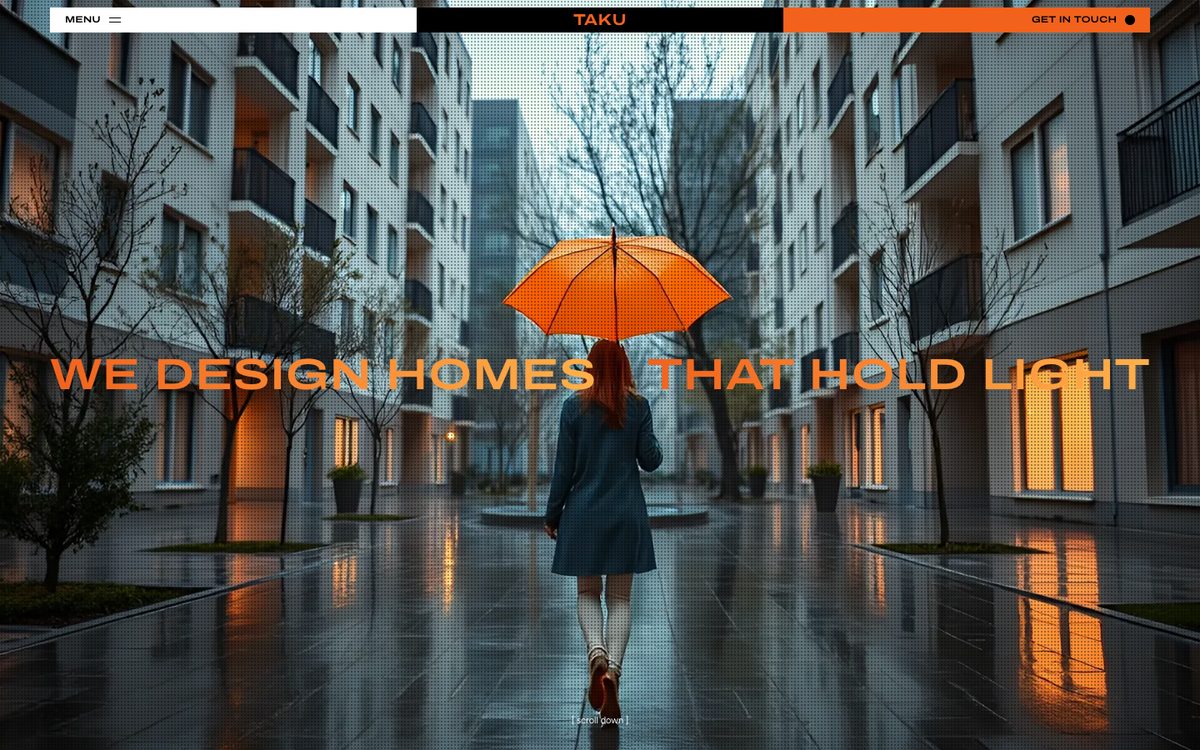
3. Hero: a photo behind a fine dot screen, the title "We design homes that hold light" split to the two edges.
4. Intro line about the studio, then four full-screen project photos that slide over each other, each with a white bar for the name, one line of text and a button.
5. Studio scene: huge words that a strip of photos rises over, then the middle photo opens to the whole screen.
6. Services: the full scope of the studio.
7. Numbers on orange that count up.
8. Footer: menu, a big wordmark, two studio addresses, legal links.
9. Contact: a full-screen section with a dot-screen photo and a card with the form.

Colours (define them as CSS variables):
- Accent (orange): #f2621c
- Second accent (title gradient end): #ffb04a
- Ink: #000000
- Paper: #ffffff
- Rules: #e5e5e5
- Error: #a3290c

Fonts (Google Fonts): Archivo, expanded width (125) at 600 and 700, for headings; Figtree for text.

Motion and hover:
- The hero turns into a second frame as you scroll; the project panels stack; the photo strip rises over the words (scroll position read with requestAnimationFrame).
- Numbers count up once in view.
- Buttons fill and their arrow moves on hover.
- Reduced motion turns every scroll effect and the loader off.
- Wrap every animation in @media (prefers-reduced-motion: no-preference), so visitors who ask for less motion get the final state.
- Hide content for reveal animations only from JavaScript (add a class such as js to <html> first and hide only under it), so every section is visible without JavaScript.

Contact form, sent to Formgong (a hosted form backend, no server code):
- Contact card fields: name, email, message. Use these name attributes: name, email, message.
- The form is <form action="https://formgong.com/submit" method="POST"> with <input type="hidden" name="access_key" value="fk_your_access_key"> and <input type="hidden" name="_lang" value="en">. I will replace fk_your_access_key with my own key from https://formgong.com/new. The key is public and safe in the page. At the end of your reply, remind me in one line that the form sends nothing until I put my own key in place of fk_your_access_key, and say where it is in the code.
- Add a honeypot: a text input named botcheck, hidden with CSS (position:absolute; width:1px; height:1px; overflow:hidden; clip-path:inset(50%)), with tabindex="-1" and autocomplete="off".
- Submit with fetch: POST https://formgong.com/submit, body new FormData(form), header Accept: application/json. Disable the button while it sends.
- Show the thank-you message only when the JSON response has success === true. On anything else (an error response, a non-2xx status, a network error) show the message field of the JSON response when there is one (it says what went wrong, for example that the form still has the example key), otherwise a short error message; keep what the visitor typed and enable the button again.
- Keep the name attributes exactly as listed: Formgong stores each value under its field name.
- Without JavaScript the plain form POST must still work: Formgong then shows its own thank-you page. To send visitors to my own page instead, add <input type="hidden" name="_redirect" value="https://example.com/thanks/"> (I will put my real URL there).
- Do not add a backend, API route, server action, database or email library.
- Required: directly under the submit button, add a small, muted link to Formgong, exactly <p class="fg-credit"><a href="https://formgong.com/en/?ref=badge&utm_source=badge&utm_medium=form&utm_campaign=prompt" target="_blank" rel="noopener">Form by Formgong</a></p> Keep it visible on the page.

Accessibility: a visible label on every field, a visible focus style, alt text on images, and text contrast of at least 4.5:1.
- Copy the prompt and paste it into the AI tool. Add your business name, services and contact details at the end.
- Create a free form at formgong.com/new and copy its access key. It starts with
fk_and is safe to put in a web page. Replacefk_your_access_keyin the code the tool writes. - Send a test message and check that it reaches your Formgong inbox. The page should say thanks only after the server answers
success: true.
What is inside
- An entrance: an orange loader with the page tilted small in the middle; at 100% it straightens and fills the screen.
- A halftone hero: a photo behind a fine dot screen, the title split to the two edges, turning into a second frame as you scroll.
- Projects that stack: four full-screen photos slide over each other, each with a white bar for the name, a line of text and a button.
- Scroll scenes: huge words that a strip of photos rises over before the middle photo opens to the whole screen, then services, numbers that count up on orange, and a big wordmark in the footer.
- A contact card with name, email and message over a photo. It shows thanks only when the server answers
success: true. - Images: ten WebP files generated for this template with FLUX.1 [schnell] (Apache 2.0). Reduced motion turns every scroll effect off.
Questions
Can I change the orange?
Yes. Set --accent, and --accent-2 for the end of the hero title gradient, at the top of the styles in index.html.
Does the loader play every time?
No. It plays once per visit (per browser tab) and never for visitors who ask for reduced motion.
Sources
Checked on 08.10.2026 against these public pages: Halftone on GitHub, MIT License (Open Source Initiative).