Why we read other people's worst reviews
We run an AI help chat for websites, and in October we had to decide what to build for it next. Instead of reading competitors' feature pages, we read their unhappy customers: the most recent one- and two-star reviews of ten AI support chatbots, written mostly in 2025 and 2026. Intercom Fin, Zendesk AI agents, Tidio Lyro, Chatwoot Captain, Crisp, Tawk.to, Chatbase, SiteGPT, Chatling, Help Scout.
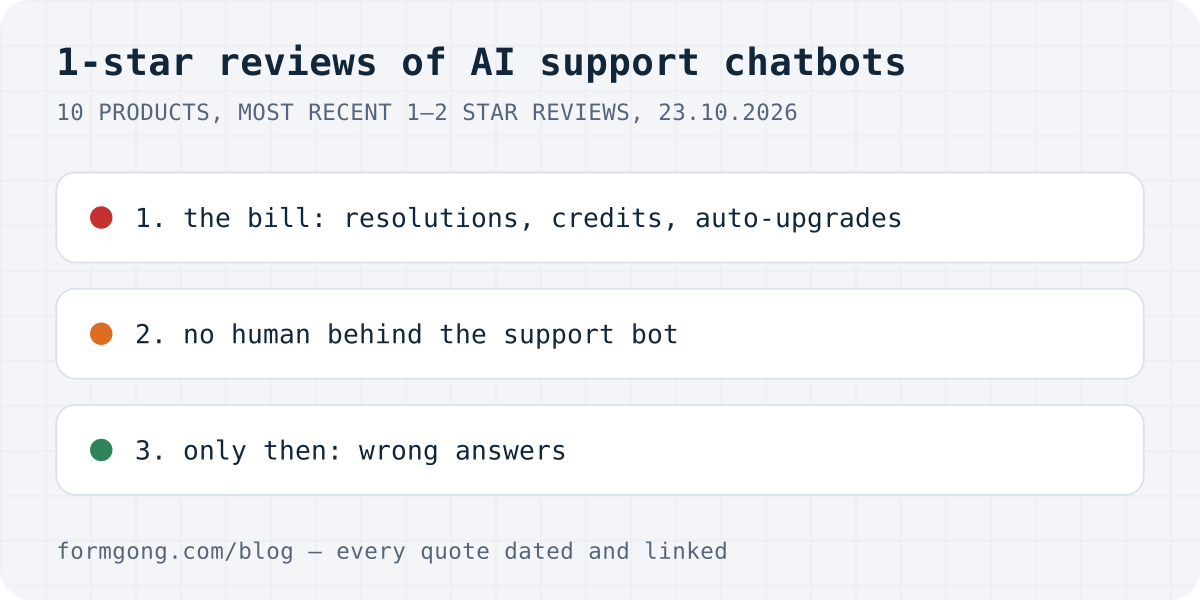
We expected the reviews to be about wrong answers. Some are. But across every product with enough reviews to read, the loudest and most repeated complaint is the bill.
Disclosure: Formgong wrote this article, and our help chat competes with every product named in it. That is a reason to check our work, so each quote below carries its date and a link to the review page it was read on, and the section after this one says exactly how many reviews we read per product.
How we counted, so you can discount us properly
Here is exactly what we read on 23.10.2026. For Intercom and Zendesk: the ten most recent 1–2★ reviews on G2. For Tidio: the ten most recent 1★ reviews on the Shopify App Store plus the ten most recent on Trustpilot. For Chatbase, Crisp, Tawk.to and Help Scout: the 1–2★ pages of their Trustpilot profiles. For Chatwoot Captain, which is open source, we read its public GitHub bug reports instead. Two products gave us almost nothing to read: Chatling has eight Trustpilot reviews, all five stars, and SiteGPT has no verifiable 1–2★ reviews from 2024–2026 on any platform we could reach. G2 and Capterra block automated reading for most products, so where we quote them, a person read the page in a browser.
These are unhappy tails, not averages. Intercom has around 2,900 G2 reviews at roughly 4.4 stars; the ten we read are the bottom of that pile. The point of reading the bottom is to learn what failure looks like, and the pattern there is hard to miss.
Complaint one: a bill you can't predict
The products in this market meter AI in three main ways, and each way has its own flavour of angry review.
Per resolution. Intercom charges for each conversation Fin "resolves", and a conversation counts as resolved when the customer confirms it or simply goes quiet after the bot's reply. Reviewers call these "assumed resolutions" and dispute them: six of the ten most recent 1–2★ G2 reviews of Fin are about billing.
“I'm scared of the costs, afraid I'll get a bill at the end of the month”
Another reviewer in the same ten measured the bot's real resolution rate, found it well below what was promised, and was still billed for conversations the bot had closed on its own. Help Scout met the same wall from the other direction: in April 2025 it moved from per-user to volume-based pricing, long-time customers published posts about their costs multiplying, and later writeups say new signups were moved back to per-user pricing. Its Trustpilot sits at 3.0, with roughly 19 of 40 reviews at one or two stars.
Per credit. Chatbase and Chatling sell credits, and one reply costs a varying number of them depending on which model answers. That makes "how many answers does my plan buy" a question with no fixed answer. Chatbase's Trustpilot profile is 26% one-star out of 72 reviews, and the sharpest ones are not about AI at all:
“Charged three times after I explicitly told them to close my account”
“they change price all the time”
Per conversation. Tidio bills Lyro per conversation, including conversations where the bot fails and hands the customer to a human. Of the twenty recent 1★ reviews we read across Shopify and Trustpilot, billing and unreachable support dominate; the bot's answer quality shows up in only three.
“I was charged twice by Tidio”
“They doubled my rate without notifying me”
One review's complaint is simply that the plan upgrades itself when you cross a threshold and never downgrades back.
There is also a quieter version of the same problem: pricing that changes under you. Crisp retired its MagicReply AI and migrated customers to a new assistant; a February 2026 review says "my previous AI workflows got deactivated without notice."
Complaint two: no human behind the bot
The second theme is support, and specifically AI-support companies whose own support is a bot. Tawk.to's unhappiest reviewers describe being "simply bounced around various useless chatbots" (June 2026, Trustpilot) and waiting two weeks without reaching a person. Tidio reviewers report the same: "No response for 2 weeks."
Wrong answers come third
Hallucinations and bad answers are real and present in the reviews. A Zendesk reviewer writes "Their AI offerings felt bolted on versus integrated," and Crisp reviewers describe bots stuck in answer loops. Chatwoot Captain's open GitHub issues include an infinite handoff loop and answers in the wrong language. But in every pile we read, answer quality came behind billing, and usually behind support too. People seem to accept that a bot sometimes misses; the one-star reviews start where they pay for the miss, or can't reach anyone to ask about the charge.
Four questions to ask before you install one
If you are choosing an AI chat for your site, the reviews suggest the pricing page deserves more attention than the demo:
- What is the billed unit: a message, a conversation, a credit, or a "resolution"? If it's a resolution, who decides the customer was satisfied?
- What happens when the bot fails and hands off to a human? Is that exchange billed like a success?
- What happens when the quota runs out mid-month? Does the bot stop, does the plan auto-upgrade, does a recharge kick in, and which of those did you agree to?
- How do you cancel, and does a human answer the support address? The reviews above were written by people who found out too late.
Where we stand, briefly
Formgong's help chat bills flat packs of answers per month. An answer is a reply the bot gives; we don't grade our own homework on whether it "resolved" anything. The pack is a hard cap: when it's used up, nothing upgrades itself, and extra capacity exists only if you buy it yourself. There's a free plan to start on. We're keeping it this way because of the pile of reviews above — the market has already run the experiment on surprise billing, and the results are sitting in public.
This article condenses a longer internal write-up: one note per competitor, every claim with a source URL and date, complaint counts with their denominators. If you want us to publish the whole set, say so.
Tell us what we got wrong
Did your experience with any of these tools match the reviews, or not at all? Tell us at support@formgong.com — especially if you think we read the wrong reviews, or a quote here has gone stale. We will check it and correct this page.
Frequently asked questions
What do people complain about most in AI chatbot reviews?
In the recent 1–2 star reviews of ten AI support chatbots we read in October 2026, billing was the most repeated complaint: disputed resolutions, variable credit costs, double charges and plans that upgrade themselves. Unreachable support came second, and wrong answers third.
What is an assumed resolution in AI chatbot pricing?
A conversation the vendor counts as resolved because the customer stopped replying after the bot's answer, not because anyone confirmed it was solved. Intercom bills Fin this way, and disputed assumed resolutions appear in six of the ten most recent 1–2 star G2 reviews we read.
Do AI chatbots charge when the bot fails to answer?
Some do. Tidio bills a Lyro conversation even when the bot fails and hands the customer to a human, and credit-metered tools still burn credits on unhelpful replies. Before you buy, ask whether a failed answer that ends in a handoff is billed like a success.
How does Formgong's help chat bill?
Flat packs of answers per month. An answer is a reply the bot gives, not a resolution Formgong judges itself. The pack is a hard cap: nothing upgrades itself when it runs out, and extra capacity exists only if you buy it yourself. There is a free plan.
Sources and documentation
Official references for this guide: G2: Fin (Intercom) 1–2 star reviews, newest first, G2: Zendesk for Customer Service 1–2 star reviews, newest first, Trustpilot: Chatbase, Trustpilot: Tidio, 1 star, Shopify App Store: Tidio 1 star reviews, newest first, Trustpilot: Help Scout, Trustpilot: Tawk.to, 1–2 stars, Trustpilot: Crisp, 1–2 stars, Bitsplitting: Whither Help Scout? (April 2025 pricing change), Chatwoot GitHub: HandoffTool infinite loop issue. AI help chat, where data is stored.