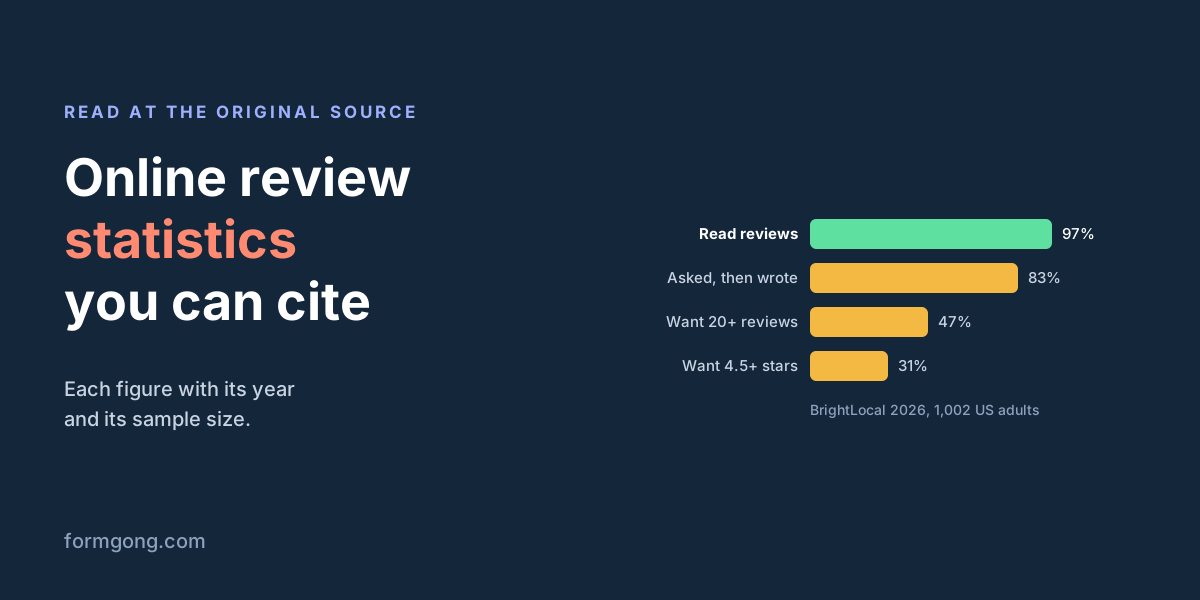
Eleven review statistics, each traced to the survey that produced it, with the sample size and year, and the gaps where the usual numbers have no source.
The short answer. In BrightLocal's 2026 survey of 1,002 US adults, 97% read reviews for local businesses and 47% would not use one with fewer than 20 reviews. Pew Research found in a 2015 survey of 4,787 US adults that 82% at least sometimes read reviews before a first purchase. Every figure here was read at its original source, with the sample.
Formgong
Online review statistics, checked at the source
Why are so many review statistics hard to trust?
You want one number for a pitch deck or a blog post, search for review statistics, and find pages with fifty of them. Follow a figure back and it often leads to another list, then a vendor blog, then nothing. Loox's “53 Online Reviews Statistics Entrepreneurs Need to Know in 2022” is a typical example of the format.
We took the opposite approach. Every number below was read on 3 November 2026 at the survey or report that first published it, with its year and how many people or reviews it covers. Where a source does not say how it collected its data, we say so. And where our own data is too small to mean much, we say that too.
Which online review statistics come from a real study?
These are the figures that survive the check. The sample column matters: a survey of 1,002 adults in one country is a different thing from data on 15 million page views at one retailer.
Each figure as its own source published it, read on 3 November 2026.
Finding
Source
Year
Sample
97% read reviews for local businesses; 41% always do
BrightLocal, Local Consumer Review Survey
2026
1,002 US adults
82% at least sometimes read reviews before a first-time purchase; 40% always or almost always
Pew Research Center
2016 (fieldwork late 2015)
4,787 US adults
47% won't use a business with fewer than 20 reviews
BrightLocal
2026
1,002 US adults
31% only use businesses rated 4.5 stars or more, up from 17% in 2025
BrightLocal
2026
1,002 US adults
74% only care about reviews from the last three months
BrightLocal
2026
1,002 US adults
A product with 5 reviews was 270% more likely to be bought than one with none
Medill Spiegel Research Center, data from PowerReviews
2017
One gift retailer: about 15.5 million page views, 1,800 products
Purchase likelihood peaks at 4.0 to 4.7 stars
Medill Spiegel Research Center
2017
Same data
More than half chose 100 reviews at 4.2 over a perfect 5.0
Judge.me shopper survey
2026
564 shoppers
78% were asked for a review last year; 83% of those asked wrote one
BrightLocal
2026
1,002 US adults
4.5 million fake reviews removed, 7.4% of all submitted
Trustpilot Trust Report
2025 (covers 2024)
61 million reviews written
Over 292 million policy-violating reviews blocked or removed on Maps
Google
2026 (covers 2025)
Over 1 billion reviews published
Most of the strongest recent data is about the US. If you sell in Europe or elsewhere, treat these as a direction rather than a measurement of your own market.
How many people read reviews before they buy?
Almost all of them, and more often than a year ago. BrightLocal's Local Consumer Review Survey 2026, a representative panel of 1,002 US adults, found that 97% read reviews when choosing a local business and 41% always do, up from 29% the year before. Pew Research Center's survey of 4,787 US adults, run in late 2015 and published in December 2016, put the share who at least sometimes read reviews before a first-time purchase at 82%, with 40% saying they always or almost always did.
Reading does not mean believing. In the same Pew survey, 51% of review readers said reviews generally give an accurate picture of a product's quality, and 48% said it is often hard to tell whether they are truthful.
How many reviews, and what rating, do buyers expect?
More than they used to, and recent ones. In BrightLocal's 2026 survey, 47% would not use a business with fewer than 20 reviews, 74% only cared about reviews from the last three months, and 31% would only use a business with 4.5 stars or more, up from 17% in 2025. Some 68% wanted at least four stars.
A perfect score is not the goal, though. The Medill Spiegel Research Center at Northwestern, working with data from PowerReviews, found in 2017 that purchase likelihood peaks between 4.0 and 4.7 stars and falls as ratings approach 5.0. Judge.me's own survey of 564 shoppers, published in May 2026, points the same way: more than half chose a store with 100 reviews at 4.2 over any version of a perfect 5.0. Judge.me does not describe how it found those shoppers, so weigh it as a vendor's survey.
How much do reviews change purchases?
A widely quoted figure is Spiegel's: at one high-end gift retailer, with about 15.5 million page views of 1,800 products over a year, a product with five reviews was 270% more likely to be bought than one with none, and the extra benefit fell quickly after the first five. The same research found a larger effect for expensive items, a 380% conversion increase against 190% for cheaper ones, and that a verified buyer badge improved the odds of purchase by 15%.
That is one retailer's data from 2017, not a law. The academic studies on reviews and sales, including Michael Luca's work on Yelp and restaurant revenue, are covered in our article on whether reviews increase sales.
How many customers write reviews, and does asking help?
Asking helps a lot. BrightLocal found that 69% of its 2026 panel had written a review of a business in the past year, 78% had been asked to, and 83% of those who were asked went on to write one. Pew's 2016 report gives an older baseline: only around one in ten Americans nearly always posted their own reviews of products, services or restaurants. Our guides on getting more reviews and on asking in person or by text turn that into steps.
How many online reviews are fake?
Nobody knows the true share, because the platforms only count what they catch. What they publish is still useful. Trustpilot's Trust Report 2025 says 61 million reviews were written on Trustpilot in 2024 and it removed 4.5 million fake ones, 7.4% of all reviews submitted, up from 6.1% in 2023; 90% were caught automatically. Google said in April 2026 that in 2025 it blocked or removed more than 292 million policy-violating reviews on Maps while publishing more than 1 billion. Yelp's report for 2025 says it filtered out nearly 500,000 suspected AI-generated reviews.
Shoppers want this taken seriously: 97% of BrightLocal's panel thought businesses should face consequences for fake reviews. In the US the FTC's fake reviews rule bans businesses from writing, selling or buying fake reviews (16 CFR 465.2).
What do our own numbers show?
Very little yet, and we would rather say so than round them up. On 3 November 2026 our production database held 158 reviews across all Formgong sites, and only 3 of them were on sites run by outside accounts; the rest are on our own test and demo sites. The 10 review sites of outside accounts had sent 0 review requests, while our own 9 sites had sent 20, all of them tests. In our search test of 29 October 2026, software review sites such as G2 were cited in 4 of 39 AI answers to questions about form tools.
None of that supports a percentage about shoppers. It does match what the surveys suggest, that asking is the step people skip: none of the 10 outside review sites on Formgong had asked a single customer yet.
Is there a Formgong advantage here?
Not on a statistics page, and we will not invent one. What these numbers suggest for any tool you use is plain: ask every customer, keep reviews recent, show the count with the rating, and do not hide the lower ones, since more of Judge.me's shoppers picked a 4.2 rating than a perfect 5.0. Our review widget shows the count next to the average and has no setting to drop low ratings, but other review apps can be set up the same way.
Have you found a number with no source?
If you have traced a popular review statistic back to its origin, or found one quoted here that its source no longer says, write to support@formgong.com. We will check it and update the table.
Frequently asked questions
What percentage of people read online reviews?
97% of 1,002 US adults in BrightLocal's 2026 survey read reviews for local businesses. In Pew Research's survey of 4,787 US adults, 82% at least sometimes read reviews before a first purchase.
How many reviews does a business need?
In BrightLocal's 2026 survey, 47% of consumers would not use a business with fewer than 20 reviews, and 74% only cared about reviews from the last three months.
What star rating do customers trust most?
Not a perfect 5.0. Spiegel Research Center found purchase likelihood peaks between 4.0 and 4.7 stars.
What share of online reviews are fake?
No one knows the true share. Trustpilot removed 4.5 million fake reviews in 2024, 7.4% of those submitted, which counts only what it detected.