What does online reputation management mean for a small business?
The phrase sounds like something an agency sells: pushing bad search results down and cleaning up a name. That is a service for companies with a press problem. For a bakery, a plumber or a small online shop, your reputation online is mostly what your reviews say, where people read them, and what you said back.
That is good news, because none of it needs an agency. It needs a routine you can keep in an hour a week. The rest of this page goes through it in the order the work comes up, with a link to a fuller guide for each step.
Where do people read reviews about your business?
In more places than you check. BrightLocal's 2026 consumer survey found people use an average of six review sites, and Google is still the biggest, used by 71% of them. For most small businesses the short list is your Google Business Profile, the reviews on your own website, and the one platform of your trade, such as a booking site for salons or a marketplace for handmade goods.
Check those once a week, at the same time, and note anything new. A weekly look is enough to answer within the time people expect, and it keeps a bad week from turning into a bad month before you notice. If customers struggle to find where to review you on Google, our guide to getting a Google review link gives you one link to send.
How do you get a steady flow of reviews?
Ask every customer, at the same point after each sale, and keep asking. The number and the age of your reviews matter almost as much as the stars. In the same survey, 47% of people said they would not use a business with fewer than 20 reviews, and 74% said they only care about reviews from the last three months. A pile of reviews from 2023 reads as a business that stopped.
Ask everyone, not only the people you expect to be happy. Google's content policy for Maps forbids selectively soliciting positive reviews and offering incentives such as discounts in exchange for a review, and it removes reviews gathered that way. Our guide to getting more customer reviews covers the timing and the wording.
How fast should you answer reviews?
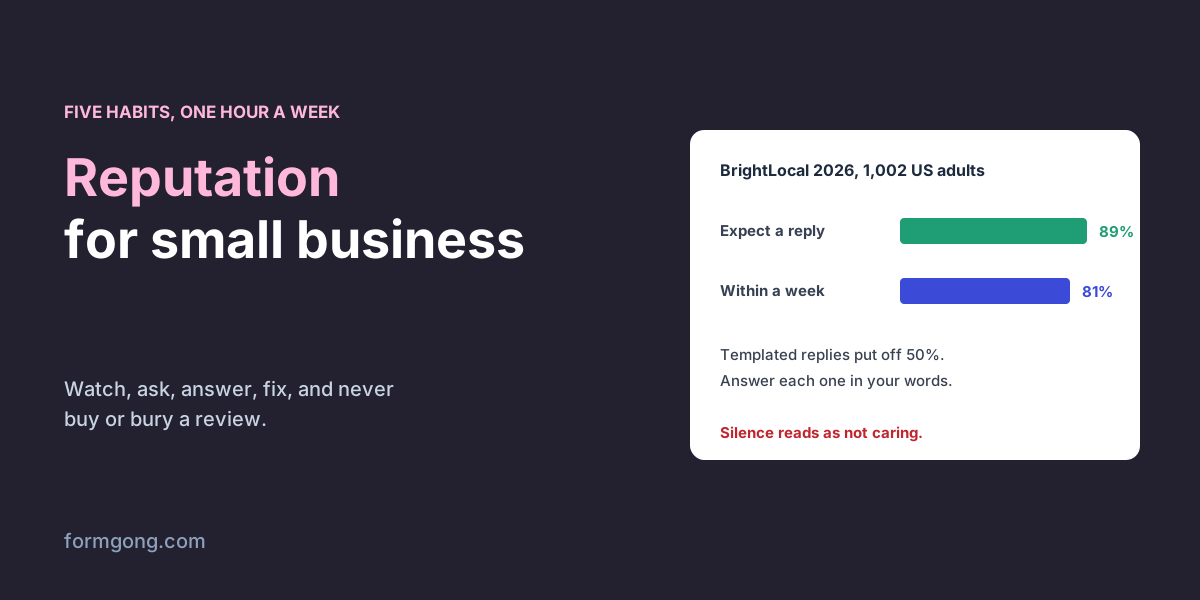
Within a week, and sooner for complaints. BrightLocal found that 81% of people expect a reply within a week and 19% expect one on the same day. Half of them, 50%, said a templated or generic reply makes them unlikely to choose the business, so a copied “Thanks for your feedback!” does almost as little as silence.
Answer the good reviews as well, briefly and by name. For the bad ones, thank the person, say what went wrong in plain words, say what you did about it, and offer a direct way to reach you. Our guide to responding to negative reviews has examples. On Google, a reply appears after a check that its help page says usually takes up to 10 minutes and sometimes up to 30 days, and the reviewer is told you replied, so a fair answer can lead them to update the review.
What do you do when the same complaint keeps coming back?
Treat it as the most useful thing your reviews tell you. One complaint about late delivery is bad luck; the fifth in a month is your courier. Count complaints by cause each month, and fix the biggest one before anything else. Our article on tagging reviews by topic explains how to count them without rereading everything.
Then say what you changed, in your replies and, if it is big, on your site. People forgive a problem that was fixed far more readily than one that keeps happening, and a visible fix turns old complaints into evidence that you listen. Our piece on the benefits of negative reviews goes into why a few of them help.
What should you never do to protect your reputation?
Do not buy reviews or write your own, and do not ask staff and friends to post them. Do not hide or delay the bad ones because they are bad, and do not offer anyone a reward to change a rating. In the US, the FTC's rule on consumer reviews, in force since October 2024, bans fake reviews and bans presenting the reviews you show as all of them while you hold back the negative ones; our article on the FTC fake reviews rule sets out what it covers.
You cannot remove an honest negative review, and you should not try. You can report a review that breaks the platform's rules, such as spam, a review of the wrong business or a personal attack, and Google's help pages explain how to flag one. Reporting a fair review because it hurts tends to fail and wastes the time you could spend answering it.
Where does Formgong fit in?
Formgong handles the reviews on your own website: it collects them from order emails or a review page, lets you approve and reply to them, and shows them with a widget. Two choices in it come straight from the rules above. Its automatic moderation reads only the text of a review and never sees the stars, so a clean one-star review goes public as quickly as a five-star one; Yotpo's guide to website review management, published on 15 January 2026, suggests instead setting rules to auto-publish reviews with 4 or 5 stars, so a low rating waits for a person to publish it. And a review email is held while the buyer still waits for your answer to a question, because a review asked for in the middle of a problem is rarely a fair one. We do not watch Google or other sites for you. The moderation docs explain the publishing modes.
We are not a model of the replying habit yet. On our demo shop Glyna, read on 3 November 2026, none of its 5 approved reviews has a reply, and 3 of the 5 are stars without text. Across the approved reviews on our own demo and test sites, 2 of 142 carry a public reply, and none of the 47 one- and two-star ones do. Those are test reviews, but the habit is the same one this page asks of you.
What takes up your reputation hour?
If you run a small business and keep a routine for reviews, tell us what takes the most time at support@formgong.com. We would like to make that part shorter.
Frequently asked questions
What is online reputation management?
Looking after what people find and read about your business online. For a small business that is mainly reviews: asking for them, answering them and fixing what they point at.
Do I need a reputation management agency?
Rarely. Most small businesses need an hour a week on reviews, not suppression services. Agencies make sense for a press or legal problem.
Can I get a bad review removed?
Only if it breaks the platform's rules, such as spam or a review of the wrong business. An honest negative review stays, so answer it well.
How quickly should I reply to a review?
Within a week at most. BrightLocal's 2026 survey found 81% of people expect a reply within a week and 19% on the same day.
Sources and documentation
Official references for this guide: Formgong: How to get more customer reviews. Moderate reviews, where data is stored.