Why does buying reviews look tempting?
You have eight reviews and the shop down the road has three hundred. Someone in your inbox offers fifty five-star Google reviews by Friday. It is easy to see the appeal, and it is not a rare thought: when we typed "buy google reviews" into Google on 6 November 2026, 9 of the 10 suggestions were about where and how to buy them, from a freelance marketplace to bulk packages; the tenth was review cards, which we come back to below. Typing "buying google reviews" brought up one more honest question among the ten: "is buying google reviews illegal".
Here is what the rules say, read at the source, and what happens to a Business Profile that is caught. It is not legal advice; if money or a lawsuit depends on it, ask a lawyer.
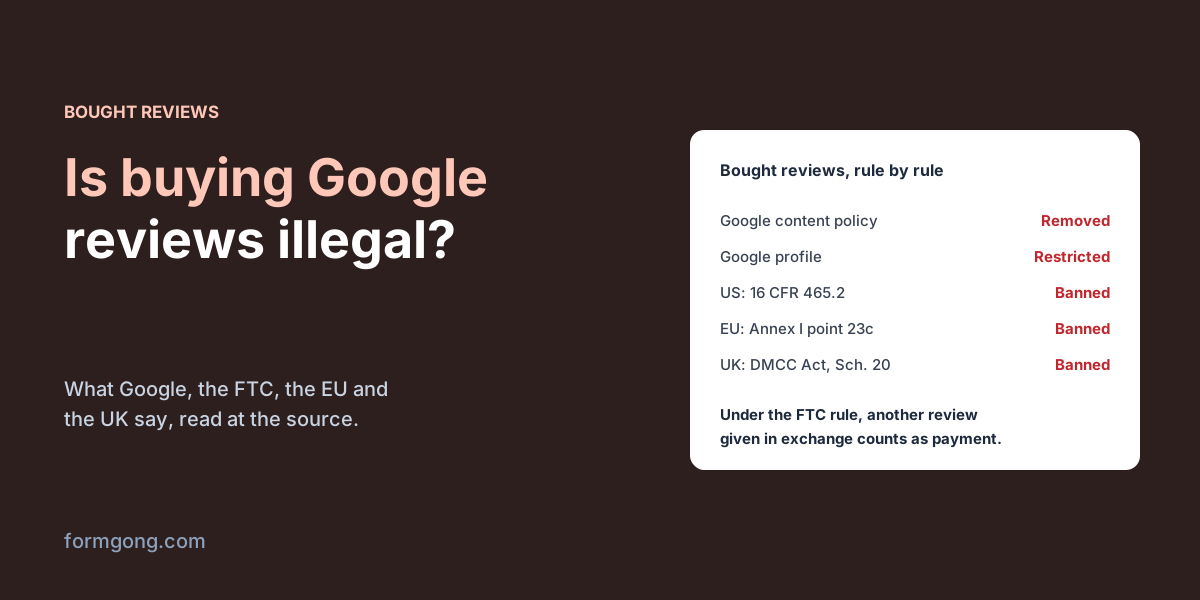
Is it illegal to buy Google reviews?
In the US, the EU and the UK, yes, and on Google it is against the rules everywhere.
| Where | Rule | What it says about bought reviews |
|---|---|---|
| Maps user content policy, fake engagement | Removes reviews “paid for, directly or in kind”; can restrict the whole profile | |
| United States | FTC rule on consumer reviews, 16 CFR 465.2 | Buying a review you knew or should have known was fake is an unfair or deceptive practice |
| European Union | Directive 2005/29/EC, Annex I point 23c (added by 2019/2161) | Commissioning false reviews is on the list of practices that are always unfair |
| United Kingdom | DMCC Act 2024, Schedule 20 paragraph 13 | Commissioning a fake review, and offering that service to traders, are banned practices |
The US rule is the most specific. Section 465.2(b) makes it an unfair or deceptive practice for a business to buy a review that it "knew or should have known" misrepresents whether the reviewer exists, whether they used the product, or what their experience was. "Should have known" matters: not asking the seller where the reviews come from does not get you out of it. The rule has been in force since 21 October 2024, and our article on the FTC fake reviews rule goes through the rest of it.
The EU rule does not care whether the reviews were paid for in money. Point 23c bans "submitting or commissioning another legal or natural person to submit false consumer reviews". The UK goes one step further and bans the sellers as well: paragraph 13 of Schedule 20 covers "offering services to traders" to write or submit fake reviews.
Does swapping reviews count as buying?
Under the US rule, yes. Section 465.1 defines buying a review as giving "something of value" in exchange for one, and lists money, gift cards, products, services, discounts, coupons, contest entries "or another review". So a group where business owners agree to review each other is buying reviews, even though no money changes hands. On Google, those reviews also fail the content policy, because the reviewers never used your business.
Section 465.8 covers fake followers and likes: buying or selling "fake indicators of social media influence" for a commercial purpose is banned too.
What does Google do to a profile with bought reviews?
First it removes the reviews. Google's content policy, read on 6 November 2026, lists reviews or ratings "that have been paid for, directly or in kind" as fake engagement, along with content posted from several accounts by one person and content that does not reflect a real experience. Its rating-manipulation section adds that "unusual volumes or patterns" of reviews are removed too, and fifty reviews in a week is the kind of pattern that wording describes.
Then it can restrict the profile. Google's help page on restrictions for policy violations lists three examples: the profile cannot receive new reviews for a set period, its existing reviews are unpublished for a set period, or customers see a warning that fake reviews were removed. Google says it emails the owner before applying a restriction, and the owner can appeal. A public warning is a worse look than eight honest reviews.
The money is gone either way. Removed reviews are not restored, as our article on Google reviews not showing up explains. And while they last, bought reviews tell you nothing about what real customers think, which is the part of reviews you can actually use.
What if the seller promises real accounts?
It changes nothing. Google's policy looks at why the review was written. A review "paid for, directly or in kind" is fake engagement whether it comes from a bot or from a real person with ten years of Maps history. The same goes for paying people to write reviews in a group or on a freelance site.
The US rule looks at what you knew. A business is liable if it bought reviews it "knew or should have known" were false, and a person who never used your business cannot write a true account of using it. The FTC's questions-and-answers page on the rule, read on 7 November 2026, adds that the rule "authorizes courts to impose civil penalties for knowing violations".
Are Google review cards the same as buying reviews?
No. When "buy google reviews" autocompletes to review cards, it means a card or stand with a QR code or NFC chip that opens your review page. That is just a way to ask, and it is allowed, with two limits from Google's policy: do not pressure people to review while they are still on your premises, and do not ask staff to collect a quota of reviews or to get themselves named in them. A free QR code does the same job as a paid card; our guide to a review QR code shows how to make one.
What works instead of buying reviews?
Asking every customer, the same way, with a link that goes straight to the review box. Google's policy allows you to "solicit or encourage" genuine reviews as long as you do not offer an incentive or try to influence the rating. A short email a few days after the purchase reaches the customers who were happy but did not think to write.
Leave rewards out of it on Google. The FTC rule allows a reward that does not depend on the rating, but Google's policy bans any incentive for a Google review, payment, discount or free product alike. Our article on offering a discount for a review sets out where each rule draws the line. Our guide to getting more customer reviews covers the asking itself.
Ask everyone, not just the customers you expect to be happy. Google's policy bans merchants from trying to "selectively solicit positive reviews from customers", and from requiring or pressuring people to leave a review while they are on your premises. The FTC's questions-and-answers page says its rule has no specific ban on asking only satisfied customers, but that the practice "could violate the FTC Act". A rule of thumb that keeps you inside both: the same request, at the same point, to every customer.
How does Formgong fit in?
Formgong does not sell reviews, does not post to Google and does not show Google reviews. It helps you ask real customers. Review request emails go to every buyer of a connected store, and our free Google review link generator makes a link and QR code that open your Google review box.
For reviews on your own website, a few defaults make a bought batch harder to slip in, though none of them can prove a review is genuine. In the modes that publish on their own, only three reviews a day from one visitor go out at once and the rest wait for you. On the Pro plan, the AI check holds a review with a link in the name or text as possible spam. Imported reviews arrive waiting for you, not published. The moderation docs list each mode.
Has someone offered you reviews?
If a seller has pitched you reviews, or you have seen a competitor's profile get a warning, tell us what happened at support@formgong.com. We will add what we can verify to this page.
Frequently asked questions
Is it illegal to buy Google reviews?
In the US, buying a review you know or should know is fake breaks the FTC's rule on consumer reviews. The EU and UK also ban commissioning fake reviews, and Google's policy bans paid reviews everywhere.
Can Google tell if reviews are bought?
Google does not publish how, but its policy removes paid reviews, reviews posted from several accounts by one person, and unusual volumes or patterns of reviews.
What happens if you get caught buying Google reviews?
Google removes the reviews and can restrict the profile: no new reviews for a period, existing reviews unpublished, or a warning to customers. It emails the owner first.
Is a review exchange with another business allowed?
No. The FTC rule counts another review as payment, and on Google the reviewers never used your business, so the reviews break the content policy.
Can I ask only happy customers for Google reviews?
No. Google's policy bans selectively asking for positive reviews. Send the same request to every customer.
Sources and documentation
Official references for this guide: Formgong: What the FTC fake reviews rule bans, Formgong: Can you offer a discount for a review?. Moderate reviews, where data is stored.