Why does your 4.8 feel weaker than a competitor's 4.6?
Your shop shows 4.8 stars. A competitor shows 4.6. Yours is higher, and yet shoppers seem to trust theirs more. The difference is usually the small grey number next to the stars: you have 5 reviews and they have 200.
An average from five people and an average from two hundred are both written as one decimal, but they carry very different amounts of information. Once you have seen how the average is built, it is easy to see why.
How is an average star rating calculated?
Add up the stars from every rating and divide by how many ratings there are. Our demo shop, Glyna, had five approved reviews when we read its public review data on 6 November 2026: four people gave 5 stars and one gave 4. That is 20 + 4 = 24 stars from 5 people, and 24 ÷ 5 = 4.8.
Google does the same for local businesses. Its Business Profile help page on review scores, read on 6 November 2026, says the score is the average of all ratings published on Google for that place, on a scale of 1 to 5, and that a new review can take up to two weeks to change it. Review apps differ mainly in which reviews they let into the sum, which we come back to below.
If you want to check a number by hand, write the star counts down from 5 to 1, multiply each by its star value, add the results and divide by the total count. A spreadsheet does it with one formula, and the result should match what your review app shows to the first decimal.
How much does one bad review move the average?
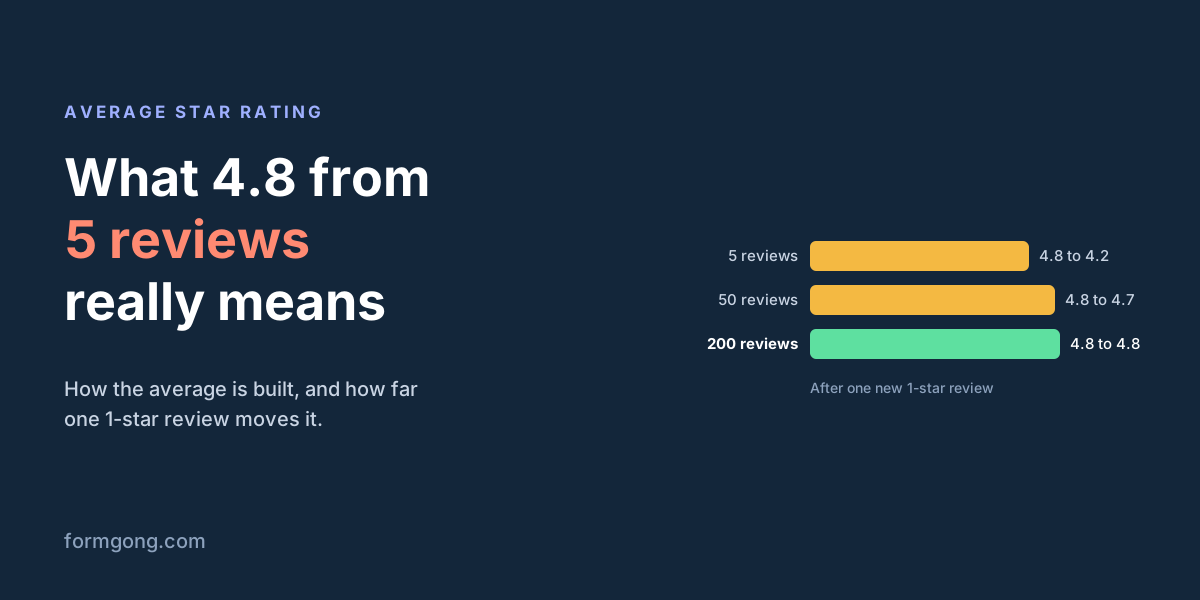
A lot, while you have only a handful. Take Glyna's 4.8 from five reviews and add a single 1-star review: 25 stars from 6 people is 4.2. The same 1-star review on top of fifty reviews averaging 4.8 leaves 4.7, and on top of two hundred it still rounds to 4.8.
| Reviews before | Average before | Average after one 1-star review |
|---|---|---|
| 5 | 4.8 | 4.2 |
| 50 | 4.8 | 4.7 |
| 200 | 4.8 | 4.8 |
This is why a new shop's rating swings from week to week and an established one barely moves. It also explains why a perfect 5.0 from three reviews persuades nobody: everyone knows the next review can knock half a star off.
How many reviews before an average means something?
There is no magic count, but there is a useful rule of thumb from basic statistics. When ratings spread by about one star, which is what a normal mix of fives, fours and the odd low score looks like, the average you see can sit up to about two divided by the square root of the count away from the one you would get with every customer's opinion.
| Reviews | The average could be off by about |
|---|---|
| 5 | 0.9 of a star |
| 20 | 0.45 |
| 50 | 0.3 |
| 100 | 0.2 |
| 400 | 0.1 |
Read the table this way. With 20 reviews, a 4.6 and a 4.4 are not really different; with 100 they start to be. So when you compare your products, ignore gaps of a tenth or two between products that have fewer than a hundred reviews each. The same goes for shoppers comparing you with a competitor, which is why showing the count matters as much as the stars. How many reviews shoppers say they want before they trust a business, and which averages sell best, are covered in our checked list of review statistics and in do reviews increase sales.
How many 5-star reviews does it take to raise your average?
More than most people guess, and more the closer you get to 5. If you have n reviews averaging a and want to reach a target t, you need n × (t − a) ÷ (5 − t) new 5-star reviews, rounded up, assuming nothing lower arrives in between.
| You have | You want | New 5-star reviews needed |
|---|---|---|
| 20 reviews at 3.5 | 4.0 | 10 |
| 20 reviews at 4.2 | 4.5 | 12 |
| 50 reviews at 4.2 | 4.5 | 30 |
| 100 reviews at 4.6 | 4.8 | 100 |
The last row is the one to notice. Going from 4.6 to 4.8 on a hundred reviews takes another hundred perfect scores, because each new 5 only pulls the average a little further towards 5. In practice some of the new reviews will be 4s and the odd 1, so the real number is higher.
There is no shortcut that keeps the number honest. Ask every customer the same way, not only the ones you expect to be happy: Google's content policy, read on 7 November 2026, lists asking selectively for positive reviews as fake engagement. Then look at what the low reviews have in common and fix that, since the cause of the next 1-star review is usually in the last few. If the question behind this is which average to aim for, do reviews increase sales covers the Spiegel Research Center's finding that purchase likelihood peaked at averages of 4.0 to 4.7, not at 5.0.
Why do some sites rank a 4.7 above a 5.0?
Because a 5.0 from three reviews tells you less than a 4.7 from two hundred, and some sites sort with that in mind. A common way is a Bayesian average: before dividing, add a set number of imaginary reviews at a typical score, so items with few reviews are pulled towards that score and items with many barely move.
An example with 10 imaginary reviews at 4.3. The product with three 5-star reviews becomes (10 × 4.3 + 15) ÷ 13 = 4.46. The product with two hundred reviews averaging 4.7 becomes (10 × 4.3 + 940) ÷ 210 = 4.68, and now sorts first. Both numbers come from running the formula, and the order flips the way most shoppers would expect.
Use this for sorting, not for the number you print. The average shown next to the stars should be the plain one, so it matches what visitors can check against the reviews and what you put in your markup. Google, for its part, describes its Business Profile score as the plain "average of all ratings published on Google". Other sites do not all publish their method, so check their help pages before you compare their numbers with yours.
How should half stars be shown?
A 4.3 has to become a row of five star shapes somehow, and there are three common ways. Some widgets round to the nearest whole star, some round to the nearest half star, and some fill the last star partly, so 4.3 shows four full stars and a third of the fifth. Partial fill is the most faithful; whole stars are the simplest to read and to make accessible.
Whichever way you draw them, print the number too. Rounding the picture can flatter a product: 4.5 drawn as five full stars looks like a perfect score. That is more than a cosmetic problem. Sahoo, Dellarocas and Srinivasan studied two years of purchases and returns at a North American specialty retailer, in a paper published in Information Systems Research in 2018. They used a jump in how that shop displayed its averages, and found that products shown with an average higher than their true rating were returned more often.
Also show how the stars are spread. Two products can both average 3.0, one because everyone found it middling and one because half loved it and half hated it. A small bar for each star value tells the shopper which it is, and it shows that your 4.8 is four fives and one four rather than something hidden.
Which reviews should count toward the average?
Every genuine review you have published, good and bad. If you hold back the 1-star reviews and publish the rest, the average goes up and stops meaning anything. In the US it is also a legal problem: the FTC rule on reviews forbids presenting the reviews you display as most or all of them while you hold some back for their low rating or negative tone, which our article on the FTC fake reviews rule explains.
Two exclusions are reasonable as long as you say what you count. Reviews still waiting for moderation are not part of the published average yet. And reviews from somewhere else, such as a marketplace, can be shown in their own list instead of being mixed into your own rating, so the number next to your stars describes one set of reviews. Label the count with what it is, for example “approved reviews: 5”, instead of a bare “5 reviews”.
How is the average shown to Google?
Through structured data on the product page: an AggregateRating with the average as ratingValue, the count as reviewCount, and the scale as bestRating 5 and worstRating 1. The average in the markup must match the one visitors see on the page. We cover the properties in detail in how to add review schema, and the reasons stars still might not appear in review stars not showing in Google.
How does Formgong calculate and show the average?
Formgong keeps a running count of approved reviews for each star value, site-wide and for each product, and divides the total stars by the total count, as above. The result is rounded to one decimal, the ordinary way, so a true 4.95 is shown as 5.0 and a 4.94 as 4.9. Only approved reviews count; pending and hidden ones never do, and reviews imported from a marketplace such as Etsy appear in their own labelled list and stay out of the average and the count.
The widget draws whole stars, rounded to the nearest one, and prints the average with one decimal and the words “approved reviews” beside them, for example “5.0 / 5 · approved reviews: 1” on Glyna's Salad Bowl page on 6 November 2026. So a 4.5 shows five filled stars next to the number 4.5; the number is the part to trust. From five approved reviews up, the widget also shows a bar for each star value, and the bars double as filters.
On Shopify and WooCommerce, Formgong adds the AggregateRating to the product's markup once the product has at least one approved review, with the average rounded to one decimal. Glyna's Salad Bowl page carried ratingValue 5 and reviewCount 1 when we read it. On a site you build yourself, the widget does not write markup, so use our review schema generator and keep its numbers in step with the widget.
You may wonder why the examples here use one small demo shop. On 6 November 2026 most review sites on Formgong with approved reviews were our own demo and test sites, and a spread of ratings built from test data would tell you nothing, so we stuck to the five reviews Glyna got from orders placed in the demo shop.
What does your rating show?
If your average does something this article does not explain, or you want a way of drawing stars we do not offer, write to us at support@formgong.com. We read every message.
Frequently asked questions
How do you calculate an average star rating?
Multiply each star value by how many ratings gave it, add the results and divide by the total number of ratings. Four 5-star ratings and one 4-star rating give 24 ÷ 5 = 4.8.
Is a 4.8 from 5 reviews better than a 4.6 from 200?
Not necessarily. With 5 reviews one bad rating can drop the average below 4.2, while 200 reviews hold steady. The larger count tells a shopper more.
Should I round star ratings to half stars?
Round the picture however you like, but always print the average with one decimal next to it. Rounding up the stars alone can make a product look better than it is.
Do hidden or pending reviews count toward the average?
They should not count while they are not published, but hiding genuine negative reviews to raise the average misleads shoppers and breaks the FTC rule in the US.
How many 5-star reviews do I need to raise my rating?
Reviews × (target − current) ÷ (5 − target). From 20 reviews at 4.2, reaching 4.5 takes 12 new 5-star reviews, if nothing lower arrives.
Sources and documentation
Official references for this guide: Formgong: Review schema markup. Review widget, where data is stored.
Related guides
- Lovable form submissions to email and Telegram
- HTML contact form without a backend: a working example
- How to send website form submissions to Telegram
- Contact form not sending email? Check where it stops
- Managing website leads in Telegram without a CRM
- Form backend for Lovable, Bolt, v0, Cursor
- Telegram bot for a contact form: build or skip?
- GDPR form backend: 7 checks before you choose
- Lovable form not sending email? 6 fixes
- Netlify Forms not working? React and Bolt fixes
- Stop contact form spam without a CAPTCHA
- GitHub Pages contact form: a working setup
- Mailto Form in HTML: Why It Fails and What to Use
- HTML form to Google Sheets: 2 free methods
- Webflow form submission limit: what to do at 50
- Turnstile vs reCAPTCHA vs hCaptcha for forms
- Contact Form 7 and Elementor forms to Telegram
- Squarespace contact form not sending email?
- Shopify contact form: where do messages go?
- Google Form to Telegram: free Apps Script way
- Wix contact form not sending email? Fixes
- EU / GDPR Formspree alternatives compared
- HTML form action attribute explained
- How do HTML forms work? The HTTP request
- Types of Injection Attacks on Web Forms (2026)
- Indirect Prompt Injection in MCP
- MCP Rug Pull Attack: Detect Tool Changes
- Form without a backend: 7 ways that work
- Thank-you page after form submission (HTML)
- Indirect Prompt Injection Examples (2023–2026)
- Indirect Prompt Injection via Email
- What Is Tool Poisoning in MCP?
- WordPress contact form without a plugin
- Send email from frontend JavaScript
- How to Prevent Indirect Prompt Injection
- Honeypot Form Field: How to Add One That Works
- Contact Form with File Upload (HTML, No PHP)
- Angular contact form without a backend
- Send form submissions to Slack or Discord without Zapier
- Verify a form webhook signature (HMAC-SHA256)
- Contact forms that send nothing: 793 AI-built sites tested
- v0 contact form that actually sends: 3 ways
- How we tested AI-built contact forms, and 12 bugs we hit
- Cloudflare vs Netlify free plan: hosting that never pauses
- EmailJS 412 “Gmail_API: Invalid grant”: reconnect Gmail
- Resend “You can only send testing emails”: verify a domain
- Supabase Edge Function blocked by CORS policy: 3 causes
- Formspree “Form not found” and other errors: fixes
- Web3Forms errors: “Invalid access key” and 403 explained
- How to add customer reviews to your website for free
- Getform not working? “This form has been deleted” and more
- Next.js contact form not working? 6 errors, reproduced
- Webflow form not sending email? What to check, tested
- FormSubmit not working? “This form needs Activation” fix
- Contact form “TypeError: Failed to fetch”: causes and fixes
- WooCommerce product enquiry form
- Contact Form 7 vs WPForms
- Gravity Forms alternative free
- WordPress contact form block
- 535-5.7.8 Username and Password not accepted (Gmail)
- 535 5.7.3 Authentication unsuccessful: Office 365 SMTP
- Nodemailer “Missing credentials for "PLAIN"”: the fix
- Nodemailer “Greeting never received”: port 465 fix
- Nodemailer SSL “wrong version number”: the port fix
- Nodemailer “self-signed certificate in certificate chain”
- Nodemailer ECONNREFUSED 127.0.0.1:587: missing SMTP host
- SendGrid “authorization grant is invalid”: 401 fix
- Mailgun 401 Forbidden: why the API rejects your key
- “Edge Function returned a non-2xx status code”: the fix
- Next.js “Body exceeded 1 MB limit”: Server Action fix
- Unexpected token '<', "<!DOCTYPE "... is not valid JSON
- “TypeError: Body is unusable”: body has already been read
- Turnstile “timeout-or-duplicate” and other siteverify errors
- Turnstile vs hCaptcha vs reCAPTCHA: speed and size tested
- Judge.me reviews not showing on Shopify: how to fix it
- Judge.me review carousel not showing: how to fix it
- Yotpo reviews not showing on Shopify? Check the app embed
- Loox reviews not showing on product page: how to fix
- Shopify reviews not showing: what to check first
- How to show reviews on Shopify
- GDPR for website forms: what each type of form needs
- WooCommerce reviews not showing: how to fix it
- Stamped.io reviews not showing on Shopify: how to fix it
- Etsy reviews not showing: why and what to do
- Trustpilot widget not loading: how to fix TrustBox
- Yotpo problems in 2026: what merchants report
- Contact Form 7 “error trying to send your message” fix
- Elementor form “Your submission failed because of an error”
- Framer form not sending email or not working: what to check
- Carrd contact form not working: plans, spam and errors
- Google review link not working: what customers see and why
- tawk.to widget not showing on your website: causes and fixes
- How to add questions and answers to your product page
- “Failed to send a request to the Edge Function”: fixes
- Next.js “Failed to find Server Action”: what it means
- Brevo “unauthorized: Key not found” 401: the fix
- Amazon SES “Email address is not verified”: the fix
- Shopify contact form not working: how to fix it
- Judge.me alternative for WooCommerce after the 2025 shutdown
- Free WooCommerce review plugins compared on the free version
- WooCommerce review reminder emails without a paid plugin
- Add Voice Recording to a Website Form
- Contact Form 7 spam: how to stop it
- WPForms not sending email: how to fix it
- Contact form emails going to spam: how to fix it
- HTML form not submitting: how to fix it
- Contact form not working: how to find the fault
- Webflow form spam: how to stop it
- Website form to Notion: how to set it up
- Website form to WhatsApp: what works and what does not
- What 1-star reviews say about AI support chatbots
- Which free form backend gives you the most submissions?
- Elfsight reviews widget not showing? Check the view limit
- Next.js contact form backend vs Server Actions
- Review stars not showing in Google search results
- How to stop duplicate form submissions
- How to see which form leads came from ChatGPT
- What happens when a form webhook fails
- When to send a review request email after an order
- How to collect video testimonials for free
- Add contact form sign-ups to Mailchimp or Klaviyo
- How to migrate from Formspree without losing submissions
- How to get a Google review link for your business
- What is a headless form backend?
- Is it safe to put a form access key in your HTML?
- AI chatbot that answers only from your website
- Minified React error #441 in Next.js
- Squarespace product reviews after Judge.me
- Accessible contact form checklist for WCAG 2.2
- How to ask a client for a testimonial by email
- How to respond to negative reviews, with examples
- 429 Too Many Requests on a contact form
- MCP server for forms in Cursor and Claude
- Can you offer a discount for a review?
- Do EU stores have to say if reviews are verified?
- Webflow form backend options compared
- How to add review schema JSON-LD to a product page
- How to turn a customer review into an Instagram post
- How to make a QR code for Google reviews
- Live chat or chatbot for a small business website
- Why people abandon your contact form halfway
- Which form backend do AI assistants pick? 54 answers
- PHP mail() not sending email, even when it returns true
- What “Failed to fetch” means, tested in three browsers
- 405 Method Not Allowed when you submit a form
- Send a contact form to more than one email address
- What is review syndication, and who needs it?
- How to save HTML form data to a database
- NetworkError when attempting to fetch resource
- Send product reviews to Google Merchant Center
- PHPMailer not working on a live server
- AI review reply generator: does it help?
- React 19 contact form with useActionState
- Astro Actions or a form backend?
- Is no-reply@wixsiteautomations.com legit?
- Where to find the Judge.me review widget code
- AI review summaries: what shoppers actually see
- Photo reviews for WooCommerce, and the GPS inside them
- Review request email templates you can copy
- Reviews in AI search: what ChatGPT and Perplexity cite
- Lead capture form with UTM tracking, built and tested
- Form design best practices, with our own form data
- Client intake form template with file upload
- What is social proof? Meaning and examples
- What is user-generated content (UGC)?
- Benefits of negative reviews for your store
- How to get your first reviews as a new store
- How to use customer reviews in your marketing
- How to get more customer reviews
- React form validation without a library, tested
- jQuery submit form with validation
- reCAPTCHA v3 setup with the server score check
- Shopify social proof that shoppers can check
- HTML file input: accept, multiple, capture and size checks
- How to add hCaptcha to a form, with the server check
- How to add invisible reCAPTCHA to a form
- Bug report form template with browser details
- What the FTC fake reviews rule bans for online stores
- How to show reviews on your homepage
- Do reviews increase sales? What the studies show
- HTML input types and what each one sends
- HTML textarea, tested in a real form
- HTML dropdown menu in a form, tested
- Do reviews help SEO? What Google says and shows
- How to add a review carousel people can read
- Product review examples that help shoppers decide
- Which trust badges actually mean something
- Customer satisfaction survey with CSAT and NPS
- JavaScript FormData and what fetch actually sends
- JavaScript form validation without a library
- Server-side form validation and what it catches
- Email validation in JavaScript, tested on 33 addresses
- Zod form validation with FormData, tested
- Store reviews vs product reviews
- How to send review requests through Klaviyo
- How to tag customer reviews by topic and mood
- Custom review form questions worth asking
- Online reputation management for small businesses
- HTML radio button groups and what they send
- HTML label tag and what screen readers hear
- HTML autocomplete attribute, tested with Chrome autofill
- HTML fieldset and legend, and what disabled leaves out
- HTML button tag and what a form button sends
- Vite contact form that still works after the build
- How to test a contact form, end to end
- How to embed a Google Form, and what it loads
- Customer feedback questions that get real answers
- How to convert a file to base64 in JavaScript
- FilePond with a form backend, and when to skip it
- Bootstrap form validation and server errors
- Tailwind form validation, tested in three browsers
- Donation form in HTML, and where the payment goes
- How to ask for a review in person or by text
- Which review sites matter for your business
- What are customer reviews, and which kinds count
- Online review statistics, checked at the source
- Best review app for Shopify and WooCommerce
- Why Gmail sends your self-hosted mail to spam
- htmx contact form that sends to another domain
- AI form builders tested, from prompt to sent form
- Headless WordPress forms with Contact Form 7, tested
- React Hook Form watch vs useWatch, and what gets sent
- Elfsight widget not working? It vanishes when views run out
- Jotform not sending emails? Check Jotform's bounce list
- Typeform not working? A white box means a blocked script
- Positive review response examples that don't sound copied
- How to remove a Google review when you can't delete it
- Google reviews not showing up? 8 causes to check in order
- Is buying Google reviews illegal? Even a review swap counts
- Which reviews can you hide? A review moderation checklist
- Reviews on a product page: where and how many to show
- SaaS testimonials: 3 of 27 had a number in them
- Do reviews reduce returns? Not when they're too good
- Testimonial examples for business: what makes one believable
- Testimonial questions to ask clients, by type of business
- Testimonial page design: a page or a section?
- Testimonial advertising rules: what the FTC requires
- Form submission canceled because the form is not connected
- Input type date format dd/mm/yyyy: what you can change
- How to disable textarea resize, or allow only vertical
- How to prevent Enter from submitting a form
- form.submit() vs requestSubmit(): what submit() skips
- Custom HTML checkbox CSS that doesn't break required
- How to reset a form after submit, and what reset() keeps
- Input type number maxlength not working? What to use
- How to create an HTML form, step by step
- Best form builder: free plans and branding, checked
- Best WordPress contact form plugin: 10 free ones compared
- How to increase form conversion rate: start with the count
- Form backend vs form builder: which one do you need?
- WordPress contact form not sending email? 3 plugins tested
- Contact Form 7 webhook? Turning it on switched our email off
- Gravity Forms webhook: what it sends and the URLs it rejects