Why ask whether reviews reduce returns?
Every return costs you twice: the shipping and handling, and the sale you thought you had. If you sell clothes, shoes or anything a shopper has to imagine on their body or in their home, returns may be the biggest cost you do not see on the product page.
Review apps often claim that reviews cut returns, and the claim sounds reasonable: a shopper who reads that a jacket runs small orders a size up. But the numbers you see quoted usually come from shopper surveys run by the review apps themselves. Yotpo's own article on the subject, read on 6 November 2026, rests on its survey of shoppers and cites no study that measured actual returns. Surveys tell you what shoppers say they would do. For what they actually did, you need order data.
Which returns can reviews prevent?
Only the ones where the product was fine but not what the shopper expected: the wrong size, a colour that looked different on screen, a sofa bigger than the room, a cream that smelled stronger than they hoped. Reviews can't help when the warehouse sent the wrong item, the parcel arrived broken or late, or someone ordered three sizes planning to keep one. Those are fixed in packing, shipping and the returns policy.
So before you change anything on the page, pull your last 50 returns and sort them into those three groups by the reason the customer gave. If most of them are damage or wrong items, reviews will not move your return rate much. If most are “too small”, “not as pictured” or “not what I expected”, the rest of this article is for you.
To see what that is worth, multiply your monthly orders by your return rate, then by the share of returns that were about expectations, then by what one return costs you. That last figure is more than the refund: the label back, the time to inspect and restock the item, and the markdown on anything you can't sell as new.
What do studies of real orders find?
We looked for peer-reviewed studies that measured returns in a shop's own order data, and read what each one reports. Three stood out. For two of them the full paper sits behind a paywall or a bot check, so what follows comes from the authors' own abstracts and, for the sample size of the first, the press release issued when it was published.
| Study | Data | What it found about returns |
|---|---|---|
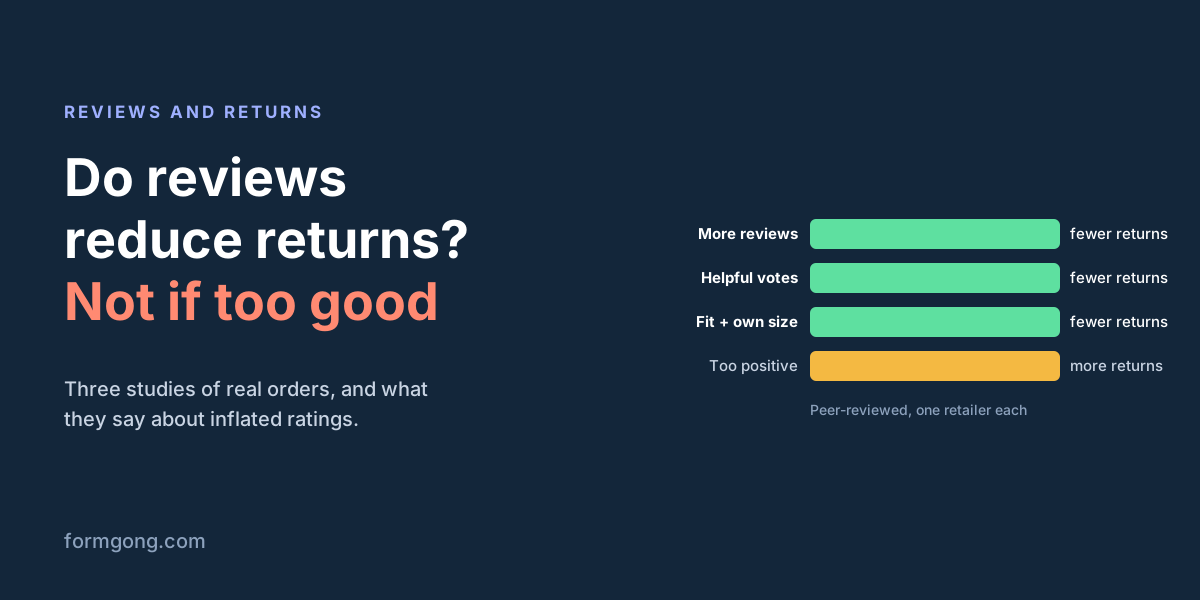
| Minnema, Bijmolt, Gensler and Wiesel, Journal of Retailing, 2016 | One European online retailer, over two years: 631,063 purchases of 2,164 electronics and furniture products | Reviews more positive than a product's long-term average brought more purchases and more returns |
| Sahoo, Dellarocas and Srinivasan, Information Systems Research, 2018 | One North American specialty retailer, two years of transactions | More reviews and more reviews voted helpful went with fewer returns; a displayed average above the true one went with more |
| Wang, Ramachandran and Sheng, Information Systems Research, 2021 | One online retailer's apparel, before and after it changed its review system | Fit comments lowered returns once reviewers' own sizes were shown with them |
The European study is the largest. Minnema and colleagues followed more than two years of sales at a big online retailer, almost 9 million page views and 631,063 purchases, and found that when a product's reviews looked more positive than its long-term average, more people bought it and more of them sent it back. The effect was stronger for first-time buyers and for cheaper products. How many reviews there were, and how much they disagreed, mattered for sales but had little or no effect on returns.
The North American study points the other way on volume. Sahoo, Dellarocas and Srinivasan compared different customers buying the same products while the set of reviews around them changed. More reviews, and more reviews that other shoppers had voted helpful, went with fewer returns after they controlled for the customer, the product and the context. When there were few reviews, people more often bought several similar items at once, which the authors read as a way to deal with uncertainty, and those extra items were what came back.
The third study looked only at fit. Wang, Ramachandran and Sheng used a change in one retailer's review system that separated two kinds of fit information: the verdict, such as “runs small”, and the reviewer's own size with the size they chose. They compared apparel returns before and after. A verdict alone helped only when most reviewers agreed. With the reviewer's size beside it, fit comments lowered returns, and negative fit comments helped too.
Is this cause and effect, or just correlation?
Some of each, and none of it is a controlled experiment. The European study measures how returns moved with what the reviews looked like at the moment of purchase, so products with glowing reviews may also have differed in ways the data does not show. The other two get closer to cause. Sahoo's team used a jump in how the retailer displayed its averages and found that products shown with a higher average than their true rating were returned more often. Wang's team used the date the review system changed, with a method called generalized synthetic control that estimates what returns would have been without the change.
Each study covers one retailer and a few categories: electronics and furniture, a specialty retailer, clothing. None tells you how many percent fewer returns your own shop will get, and you should be wary of any article that does. What they agree on is the direction: reviews that describe the product accurately help people buy the right thing, and reviews that make it look better than it is lead to disappointment and returns.
What should you change to get fewer returns?
Get more reviews on each product, steadily, by asking every buyer once after delivery. Thin products are where shoppers hedge by ordering two sizes.
Do not inflate the rating. Publish the lukewarm and negative reviews along with the rest, show the average as a number next to the stars, and avoid anything that tilts the mix toward five stars, such as asking only happy customers or rewarding only good reviews. Our article on the average star rating explains why a rounded-up picture misleads, and the European study is the reason it costs you money as well as trust.
For anything with a size, ask about fit with a reference point. A scale from runs small to runs large is the start; add the size the reviewer bought and their usual size, so a shopper can find someone like them. Our guide to custom review form questions covers how to set these up without making the form long.
Do the same for other categories, with the question that matches why people send that kind of product back. For furniture, ask which room it went in and how hard the assembly was. For electronics, ask what the reviewer used it with and how the setup went. For beauty, ask about skin type and whether the shade matched the photo. For anything that wears, ask how it has held up after a few weeks. A blank text box gets you “love it”; a specific question gets an answer the next buyer can use.
Ask for photos. Colour and size are the two things words describe worst, and a customer's photo in ordinary light shows the product as it arrives rather than as the studio lit it. None of the three studies measured photos separately, so treat this as common sense, not a proven effect.
Let shoppers vote reviews helpful and sort by it. In the North American study, the share of helpful reviews mattered, not only their number.
Put the reviews where the decision is made. A review only prevents a return if it is read before the order. A line such as “most reviewers say it runs small” belongs next to the size picker, customer photos belong beside the product photos, and the default sort should not push the critical reviews out of sight.
Read the reviews from people who returned things. Sahoo's team found that customers who send a product back are more likely to write a review, and that those reviews are more negative. Reply to them, and count what they complain about; review tagging shows one way to sort complaints by cause.
Read your return reasons too. Once a quarter, take the most common reason for each of your most-returned products and check whether the product page answers it. “Too small” on one item means a sizing note on that page. “Not as pictured” means your photos flatter it. The same fault in many reviews, such as a zip that sticks, is a product problem for your supplier, and no page copy will fix it.
How do you know if it worked?
Not from your store-wide return rate, which moves with the season, the sales you run and the mix of products people buy. Measure product by product:
- Pick 6 to 10 products with high return rates and write down each one's return rate and number of reviews today.
- Make the changes above on half of them and leave the other half as they are.
- Wait at least one full return window after the change, plus a few weeks for returns to arrive and be processed. With a 30-day policy, a result in week two means nothing.
- Compare the two groups over the same weeks, not each product with its own past.
- Look at the return reasons as well as the rate. If “too small” falls and “arrived damaged” rises, the reviews did their part and something else changed.
Expect a modest result. Reviews work on one kind of return, and a few points off the rate of your worst products is a good outcome.
How does Formgong help with this?
Formgong's customer questions let you add up to five questions to every review form, as a choice or a scale, on every plan including Free. A fit setup could be a scale question with Runs small, True to size and Runs large, a choice question for the size bought, and one for the reviewer's usual size. Answers show on each review card, the scale gets an average bar above the reviews, and shoppers can filter the list by an answer, such as everyone who usually wears a medium. The questions on reviews docs show the steps.
Customers can attach photos and a video to their review on every plan, and the files go public only together with an approved review; once there are five approved reviews and one of them has a photo, the widget's toolbar shows a “With photos” filter. If you switch on Ask the author, a shopper can email a question to a reviewer who agreed to it, such as what size they normally wear, without either one seeing the other's address. There is no separate Q&A where you answer product questions yourself, so put those answers in the product description.
You can also turn on a Helpful button on each review and let shoppers sort by most helpful. Reviews are shown newest first by default, and the widget counts only approved reviews and says so, so nothing on the page claims more than it holds.
We cannot show you a returns figure from our own customers. Formgong does not see your orders' returns, and on 6 November 2026 none of the 16 review sites on Formgong had set up customer questions yet, so there is no fit data to compare. If you try it, we would like to hear how it goes.
Have reviews changed your returns?
If you have numbers from your own shop, before and after reviews or fit questions, or a study we missed, write to us at support@formgong.com. We will add anything we can check.
Frequently asked questions
Do product reviews reduce returns?
Accurate ones usually do. In a two-year study of a North American retailer, more reviews and more helpful reviews went with fewer returns, after controlling for customer and product.
Can positive reviews increase returns?
Yes. In a study of 631,063 purchases at a European retailer, reviews more positive than a product's long-term average brought more sales and more returns.
Do fit comments in reviews reduce clothing returns?
In one retailer's apparel data they did, once reviewers also gave their own size and the size they bought. A bare runs small helped only when most reviewers agreed.
Is the link between reviews and returns proven?
Not by a controlled experiment. Two studies use natural changes at one retailer each and get close to cause and effect; the third measures association.
Sources and documentation
Official references for this guide: Formgong: Do reviews increase sales?. Questions on reviews, where data is stored.
Related guides
- Lovable form submissions to email and Telegram
- HTML contact form without a backend: a working example
- How to send website form submissions to Telegram
- Contact form not sending email? Check where it stops
- Managing website leads in Telegram without a CRM
- Form backend for Lovable, Bolt, v0, Cursor
- Telegram bot for a contact form: build or skip?
- GDPR form backend: 7 checks before you choose
- Lovable form not sending email? 6 fixes
- Netlify Forms not working? React and Bolt fixes
- Stop contact form spam without a CAPTCHA
- GitHub Pages contact form: a working setup
- Mailto Form in HTML: Why It Fails and What to Use
- HTML form to Google Sheets: 2 free methods
- Webflow form submission limit: what to do at 50
- Turnstile vs reCAPTCHA vs hCaptcha for forms
- Contact Form 7 and Elementor forms to Telegram
- Squarespace contact form not sending email?
- Shopify contact form: where do messages go?
- Google Form to Telegram: free Apps Script way
- Wix contact form not sending email? Fixes
- EU / GDPR Formspree alternatives compared
- HTML form action attribute explained
- How do HTML forms work? The HTTP request
- Types of Injection Attacks on Web Forms (2026)
- Indirect Prompt Injection in MCP
- MCP Rug Pull Attack: Detect Tool Changes
- Form without a backend: 7 ways that work
- Thank-you page after form submission (HTML)
- Indirect Prompt Injection Examples (2023–2026)
- Indirect Prompt Injection via Email
- What Is Tool Poisoning in MCP?
- WordPress contact form without a plugin
- Send email from frontend JavaScript
- How to Prevent Indirect Prompt Injection
- Honeypot Form Field: How to Add One That Works
- Contact Form with File Upload (HTML, No PHP)
- Angular contact form without a backend
- Send form submissions to Slack or Discord without Zapier
- Verify a form webhook signature (HMAC-SHA256)
- Contact forms that send nothing: 793 AI-built sites tested
- v0 contact form that actually sends: 3 ways
- How we tested AI-built contact forms, and 12 bugs we hit
- Cloudflare vs Netlify free plan: hosting that never pauses
- EmailJS 412 “Gmail_API: Invalid grant”: reconnect Gmail
- Resend “You can only send testing emails”: verify a domain
- Supabase Edge Function blocked by CORS policy: 3 causes
- Formspree “Form not found” and other errors: fixes
- Web3Forms errors: “Invalid access key” and 403 explained
- How to add customer reviews to your website for free
- Getform not working? “This form has been deleted” and more
- Next.js contact form not working? 6 errors, reproduced
- Webflow form not sending email? What to check, tested
- FormSubmit not working? “This form needs Activation” fix
- Contact form “TypeError: Failed to fetch”: causes and fixes
- WooCommerce product enquiry form
- Contact Form 7 vs WPForms
- Gravity Forms alternative free
- WordPress contact form block
- 535-5.7.8 Username and Password not accepted (Gmail)
- 535 5.7.3 Authentication unsuccessful: Office 365 SMTP
- Nodemailer “Missing credentials for "PLAIN"”: the fix
- Nodemailer “Greeting never received”: port 465 fix
- Nodemailer SSL “wrong version number”: the port fix
- Nodemailer “self-signed certificate in certificate chain”
- Nodemailer ECONNREFUSED 127.0.0.1:587: missing SMTP host
- SendGrid “authorization grant is invalid”: 401 fix
- Mailgun 401 Forbidden: why the API rejects your key
- “Edge Function returned a non-2xx status code”: the fix
- Next.js “Body exceeded 1 MB limit”: Server Action fix
- Unexpected token '<', "<!DOCTYPE "... is not valid JSON
- “TypeError: Body is unusable”: body has already been read
- Turnstile “timeout-or-duplicate” and other siteverify errors
- Turnstile vs hCaptcha vs reCAPTCHA: speed and size tested
- Judge.me reviews not showing on Shopify: how to fix it
- Judge.me review carousel not showing: how to fix it
- Yotpo reviews not showing on Shopify? Check the app embed
- Loox reviews not showing on product page: how to fix
- Shopify reviews not showing: what to check first
- How to show reviews on Shopify
- GDPR for website forms: what each type of form needs
- WooCommerce reviews not showing: how to fix it
- Stamped.io reviews not showing on Shopify: how to fix it
- Etsy reviews not showing: why and what to do
- Trustpilot widget not loading: how to fix TrustBox
- Yotpo problems in 2026: what merchants report
- Contact Form 7 “error trying to send your message” fix
- Elementor form “Your submission failed because of an error”
- Framer form not sending email or not working: what to check
- Carrd contact form not working: plans, spam and errors
- Google review link not working: what customers see and why
- tawk.to widget not showing on your website: causes and fixes
- How to add questions and answers to your product page
- “Failed to send a request to the Edge Function”: fixes
- Next.js “Failed to find Server Action”: what it means
- Brevo “unauthorized: Key not found” 401: the fix
- Amazon SES “Email address is not verified”: the fix
- Shopify contact form not working: how to fix it
- Judge.me alternative for WooCommerce after the 2025 shutdown
- Free WooCommerce review plugins compared on the free version
- WooCommerce review reminder emails without a paid plugin
- Add Voice Recording to a Website Form
- Contact Form 7 spam: how to stop it
- WPForms not sending email: how to fix it
- Contact form emails going to spam: how to fix it
- HTML form not submitting: how to fix it
- Contact form not working: how to find the fault
- Webflow form spam: how to stop it
- Website form to Notion: how to set it up
- Website form to WhatsApp: what works and what does not
- What 1-star reviews say about AI support chatbots
- Which free form backend gives you the most submissions?
- Elfsight reviews widget not showing? Check the view limit
- Next.js contact form backend vs Server Actions
- Review stars not showing in Google search results
- How to stop duplicate form submissions
- How to see which form leads came from ChatGPT
- What happens when a form webhook fails
- When to send a review request email after an order
- How to collect video testimonials for free
- Add contact form sign-ups to Mailchimp or Klaviyo
- How to migrate from Formspree without losing submissions
- How to get a Google review link for your business
- What is a headless form backend?
- Is it safe to put a form access key in your HTML?
- AI chatbot that answers only from your website
- Minified React error #441 in Next.js
- Squarespace product reviews after Judge.me
- Accessible contact form checklist for WCAG 2.2
- How to ask a client for a testimonial by email
- How to respond to negative reviews, with examples
- 429 Too Many Requests on a contact form
- MCP server for forms in Cursor and Claude
- Can you offer a discount for a review?
- Do EU stores have to say if reviews are verified?
- Webflow form backend options compared
- How to add review schema JSON-LD to a product page
- How to turn a customer review into an Instagram post
- How to make a QR code for Google reviews
- Live chat or chatbot for a small business website
- Why people abandon your contact form halfway
- Which form backend do AI assistants pick? 54 answers
- PHP mail() not sending email, even when it returns true
- What “Failed to fetch” means, tested in three browsers
- 405 Method Not Allowed when you submit a form
- Send a contact form to more than one email address
- What is review syndication, and who needs it?
- How to save HTML form data to a database
- NetworkError when attempting to fetch resource
- Send product reviews to Google Merchant Center
- PHPMailer not working on a live server
- AI review reply generator: does it help?
- React 19 contact form with useActionState
- Astro Actions or a form backend?
- Is no-reply@wixsiteautomations.com legit?
- Where to find the Judge.me review widget code
- AI review summaries: what shoppers actually see
- Photo reviews for WooCommerce, and the GPS inside them
- Review request email templates you can copy
- Reviews in AI search: what ChatGPT and Perplexity cite
- Lead capture form with UTM tracking, built and tested
- Form design best practices, with our own form data
- Client intake form template with file upload
- What is social proof? Meaning and examples
- What is user-generated content (UGC)?
- Benefits of negative reviews for your store
- How to get your first reviews as a new store
- How to use customer reviews in your marketing
- How to get more customer reviews
- React form validation without a library, tested
- jQuery submit form with validation
- reCAPTCHA v3 setup with the server score check
- Shopify social proof that shoppers can check
- HTML file input: accept, multiple, capture and size checks
- How to add hCaptcha to a form, with the server check
- How to add invisible reCAPTCHA to a form
- Bug report form template with browser details
- What the FTC fake reviews rule bans for online stores
- How to show reviews on your homepage
- Do reviews increase sales? What the studies show
- HTML input types and what each one sends
- HTML textarea, tested in a real form
- HTML dropdown menu in a form, tested
- Do reviews help SEO? What Google says and shows
- How to add a review carousel people can read
- Product review examples that help shoppers decide
- Which trust badges actually mean something
- Customer satisfaction survey with CSAT and NPS
- JavaScript FormData and what fetch actually sends
- JavaScript form validation without a library
- Server-side form validation and what it catches
- Email validation in JavaScript, tested on 33 addresses
- Zod form validation with FormData, tested
- Store reviews vs product reviews
- How to send review requests through Klaviyo
- How to tag customer reviews by topic and mood
- Custom review form questions worth asking
- Online reputation management for small businesses
- HTML radio button groups and what they send
- HTML label tag and what screen readers hear
- HTML autocomplete attribute, tested with Chrome autofill
- HTML fieldset and legend, and what disabled leaves out
- HTML button tag and what a form button sends
- Vite contact form that still works after the build
- How to test a contact form, end to end
- How to embed a Google Form, and what it loads
- Customer feedback questions that get real answers
- How to convert a file to base64 in JavaScript
- FilePond with a form backend, and when to skip it
- Bootstrap form validation and server errors
- Tailwind form validation, tested in three browsers
- Donation form in HTML, and where the payment goes
- How to ask for a review in person or by text
- Which review sites matter for your business
- What are customer reviews, and which kinds count
- Online review statistics, checked at the source
- Best review app for Shopify and WooCommerce
- Why Gmail sends your self-hosted mail to spam
- htmx contact form that sends to another domain
- AI form builders tested, from prompt to sent form
- Headless WordPress forms with Contact Form 7, tested
- React Hook Form watch vs useWatch, and what gets sent
- Elfsight widget not working? It vanishes when views run out
- Jotform not sending emails? Check Jotform's bounce list
- Typeform not working? A white box means a blocked script
- Positive review response examples that don't sound copied
- How to remove a Google review when you can't delete it
- Google reviews not showing up? 8 causes to check in order
- Is buying Google reviews illegal? Even a review swap counts
- Which reviews can you hide? A review moderation checklist
- Average star rating: what 4.8 from 5 reviews means
- Reviews on a product page: where and how many to show
- SaaS testimonials: 3 of 27 had a number in them
- Testimonial examples for business: what makes one believable
- Testimonial questions to ask clients, by type of business
- Testimonial page design: a page or a section?
- Testimonial advertising rules: what the FTC requires
- Form submission canceled because the form is not connected
- Input type date format dd/mm/yyyy: what you can change
- How to disable textarea resize, or allow only vertical
- How to prevent Enter from submitting a form
- form.submit() vs requestSubmit(): what submit() skips
- Custom HTML checkbox CSS that doesn't break required
- How to reset a form after submit, and what reset() keeps
- Input type number maxlength not working? What to use
- How to create an HTML form, step by step
- Best form builder: free plans and branding, checked
- Best WordPress contact form plugin: 10 free ones compared
- How to increase form conversion rate: start with the count
- Form backend vs form builder: which one do you need?
- WordPress contact form not sending email? 3 plugins tested
- Contact Form 7 webhook? Turning it on switched our email off
- Gravity Forms webhook: what it sends and the URLs it rejects