Why is it hard to know which review sites to focus on?
You have a handful of reviews scattered across Google, Facebook and maybe Yelp, and every list of “best review sites” you find has twenty-five entries. You cannot keep all of them alive, so you want to know where your customers actually look and write.
Many of those lists come from companies that sell review tools, and some put themselves at the top. Trustindex's “The 25 Best Review Platforms Ranked”, published in September 2021, ranks Trustindex first, ahead of Tripadvisor and Google. This page uses survey data and the platforms' own published numbers instead, and adds what we counted ourselves.
Which review sites do customers actually use?
The best recent survey is BrightLocal's Local Consumer Review Survey 2026, a representative panel of 1,002 US adults. People in it used six different review sites on average when choosing a local business.
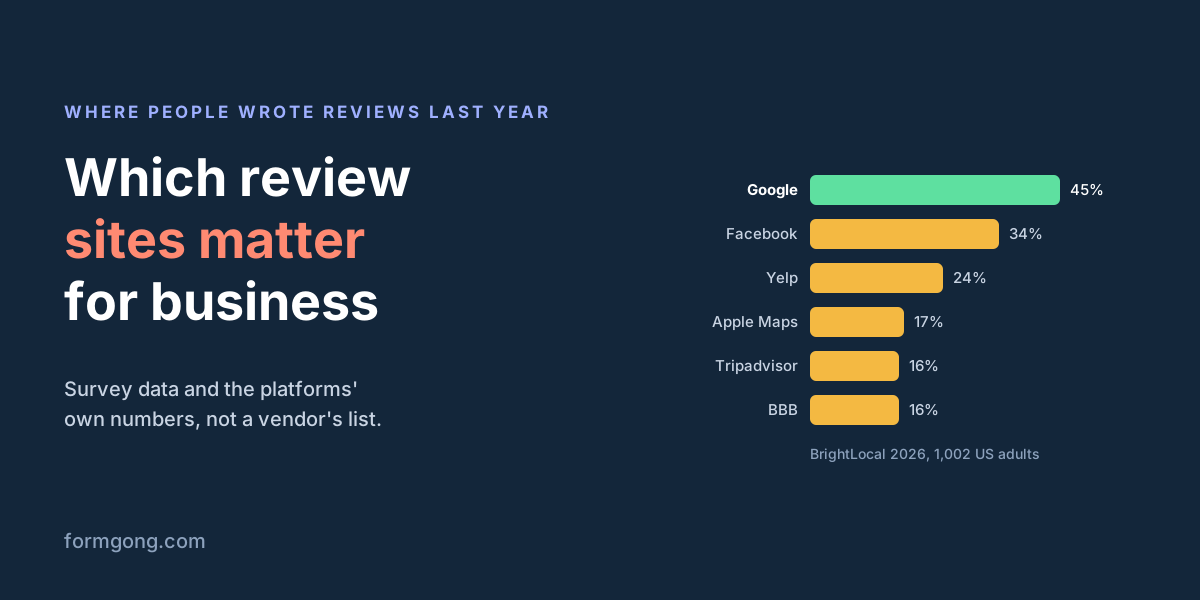
Google was the top source for reviews at 71%, down from 83% in 2025. As a source of local recommendations, ChatGPT and other AI tools came third at 45%, up from 6% a year earlier, and Apple Maps nearly doubled to 27%. For writing reviews, the order in the past year was Google 45%, Facebook 34%, Yelp 24%, Apple Maps 17%, and Tripadvisor and the Better Business Bureau at 16% each. Apple Maps only asks for a rating, not a written review, which BrightLocal thinks explains why it ranks higher for writing than for reading.
Two things follow. Google is still where most of your reviews will come from, so your Google review link is the one to put on cards and receipts. And because people check several sites, one strong profile with nothing elsewhere looks thinner than it is.
How big are Google, Yelp and Trustpilot?
The platforms publish their own figures, and they show very different sizes and rules.
Google said in April 2026 that it published more than 1 billion helpful reviews on Maps in 2025, and blocked or removed more than 292 million that broke its policies. Yelp's Trust & Safety Report for 2025 says 22 million reviews were contributed in 2025. Yelp requires a written review with every star rating, and its recommended reviews average 446 characters, so a Yelp review tends to say more than a bare rating. Trustpilot's Trust Report 2025 counts more than 61 million reviews written in 2024 and 4.5 million fake reviews removed, 7.4% of all reviews submitted.
Those removal numbers are a reminder that every big platform filters what it publishes. A review you were promised may never appear, and one that breaks a rule can disappear later.
Which review sites fit which kind of business?
The right first site depends on how customers find you. A plumber is found on a map, a shop is judged on its product page, and a software tool is compared on software directories.
| Business | Start with | Then | Note |
|---|---|---|---|
| Local service (trades, salons, clinics) | Google Business Profile | Facebook, Apple Maps, Yelp, BBB | Ask on Google; on Yelp, only say you are listed |
| Restaurant, café, hotel | Google Business Profile | Tripadvisor, Yelp, Facebook | 16% of BrightLocal's panel wrote a Tripadvisor review last year |
| Online shop | Product reviews on your own site | Google Shopping ratings, Trustpilot for store reviews | Shoppers decide on the product page |
| Seller on a marketplace | The marketplace itself (Etsy, Amazon) | Your own site, if you also sell there | Marketplace rules apply to every ask |
| Software or online tool | G2, Capterra | Trustpilot, Product Hunt | These are the review sites AI answers cited in our test |
For online shops the review that sells is usually the one on the product page, written by someone who bought that product. Our article on store reviews and product reviews explains why the two do different jobs. Trustpilot and Google's seller ratings then cover the question “is this shop safe to buy from”, which product reviews do not answer.
Can you ask for reviews on every site?
No, and the rules differ more than most people expect.
Google lets you ask, as long as you do not offer incentives, pressure people on your premises or “selectively solicit positive reviews”, in the words of its Maps content policy. Trustpilot encourages invitations but says they must go to everyone in the same way, whether you expect praise or complaints. Yelp is the exception: its support page “Don't Ask for Reviews” tells businesses not to ask customers, friends or family at all, and says its software may not recommend reviews that look prompted. On Yelp, the most you should do is mention that you are listed there.
So build your asking around the sites that allow it, and let Yelp grow on its own. Our guide on getting more customer reviews covers how to ask.
Which review sites do AI assistants cite?
With 45% of BrightLocal's panel using AI tools for local recommendations, it is fair to ask which review sites those tools read. We can only answer for our own field. In our re-check on 29 October 2026, we put 20 questions about form tools to ChatGPT, Perplexity and Google. Across the 39 AI answers, 4 cited a software review site such as G2 or Capterra, all of them from Perplexity; ChatGPT cited none in 20 answers. G2 appeared in 6 of the 7 engine and query pairs that cited any review site, and Trustpilot in none.
Those are questions about software, not about local businesses or shop products, so they tell you little about restaurants. They do suggest that for a software product a G2 or Capterra profile is worth having. The full count is in our article on reviews in AI search.
Where does your own site fit?
Third-party sites belong to someone else: they set the rules, filter the reviews and can change their layout tomorrow. Reviews on your own site are the ones you can show next to the product and keep if you switch tools. Formgong collects them and shows them with the review widget, and for WooCommerce shops it also builds a Google Merchant Center feed from your approved reviews with text, so they can appear as product ratings in Google Shopping. That feed is on the free plan; Shopify shops get it through our app, which is still waiting for Shopify's App Store review. Reviews you bring in from Etsy are shown in a separate block and are not counted in your rating.
We do not collect reviews for Google, Yelp or Trustpilot, and we do not monitor them for you. Tools such as Trustindex, which says on its own pages that it integrates 133 review platforms, are stronger if you want reviews from many sites pulled into one widget. If Trustpilot is the site you are weighing, our Trustpilot alternative page compares the two approaches.
Which review sites bring you customers?
If one review site sends you far more customers than the others, or one turned out to be a waste of time, tell us at support@formgong.com. We would like to add real cases to this page.
Frequently asked questions
What is the most used review site?
Google. In BrightLocal's 2026 survey of 1,002 US adults, 71% used Google to read reviews of local businesses and 45% had written a Google review in the past year.
Is Yelp still worth it for a small business?
For restaurants and local services in the US, often yes: 24% of BrightLocal's panel wrote a Yelp review last year. But Yelp asks businesses not to request reviews, so it grows on its own.
Which review sites matter for an online store?
Your own product pages first, then Google Shopping ratings and a store review site such as Trustpilot to show the shop itself can be trusted.
How many review sites should a business be on?
Pick two or three where your customers already are. Consumers in BrightLocal's survey used six sites on average, but a few active profiles beat many empty ones.
Sources and documentation
Official references for this guide: Formgong: Reviews in AI search. Google Merchant Center review feed, where data is stored.