Is a bad review hurting your sales?
A one-star review lands on your best product, and it feels like a sign on the door telling people to stay away. Your first thought is to hide it, or to bury it under a few friendly five-star ones.
Before you do, it helps to look at how the stores everyone shops at live with bad reviews, and at what a shopper actually does with one. A single complaint is rarely the problem. A page that looks cleaned up often is.
How many bad reviews do well-known stores have?
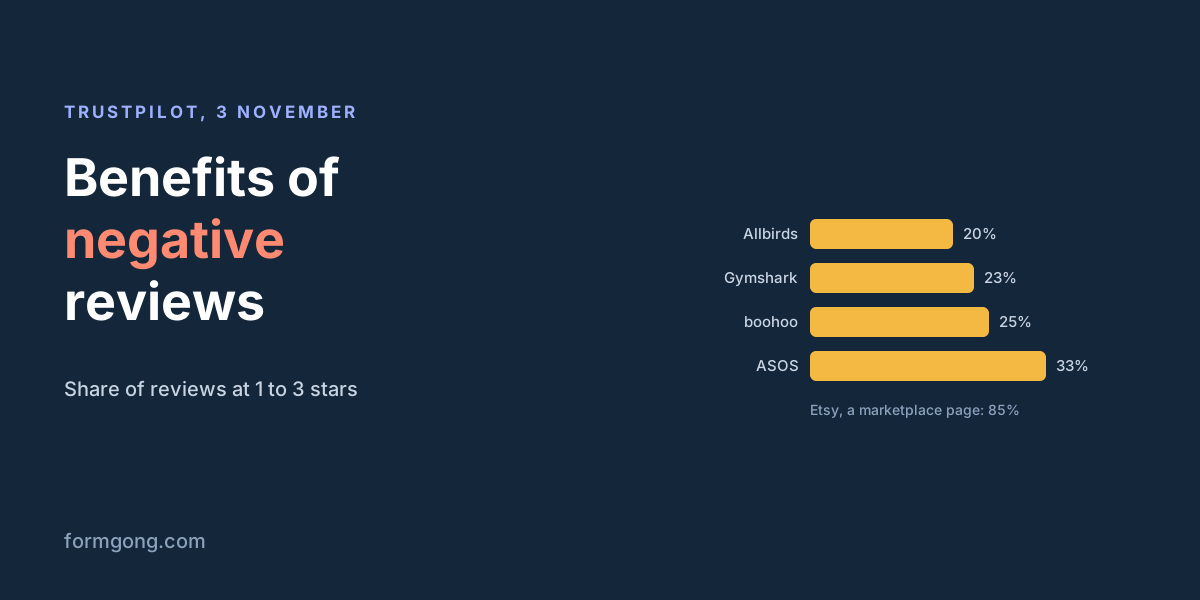
On 3 November 2026 we read the Trustpilot pages of five online stores and noted how their reviews split by stars:
| Store | Reviews | 1 star | 1 to 3 stars |
|---|---|---|---|
| Allbirds | 2,696 | 12% | 20% |
| Gymshark | 42,485 | 17% | 23% |
| boohoo | 208,182 | 15% | 25% |
| ASOS | 192,324 | 28% | 33% |
| Etsy | 21,593 | 80% | 85% |
Four of the five sit between a fifth and a third of reviews at 3 stars or less, and people keep buying from all of them. Etsy is the outlier, and its page reviews the marketplace as a company, not the shops that sell on it. Company reviews are often written after a delivery or a refund went wrong, so they may run harsher than reviews of a product. So don't read these as targets. Read them as a reminder that a visible share of unhappy customers is normal, even for brands with huge sales.
Why do a few bad reviews make the rest believable?
Shoppers know that every product disappoints someone. When a page has 40 reviews and all of them are glowing, the careful buyer does not think “perfect product”. They wonder what was removed, or who wrote the reviews. Yotpo's article on publishing every review, updated on 8 October 2026, makes the same point, and so does Loox's article on why a Shopify store needs negative reviews.
A few complaints change that. They show the reviews are not filtered, so the good ones count for more. They also show the scale of the problem: “the handle is a bit small” from one buyer in twenty is useful, and it is not a reason to leave.
What does a bad review tell the next buyer?
Some visitors scroll straight to the low ratings, and they are not looking for a reason to say no. They want to know what the worst case looks like. If the worst anyone says about your mug is that it arrived late at Christmas, a buyer in March relaxes.
Your reply matters as much as the review. A calm, specific answer under a complaint shows what happens when something goes wrong with you, and that is the real question behind most of these reads. Our guide on how to respond to negative reviews has examples for the common cases.
Why do the stars and the words often disagree?
Often because people pick the stars in a second and take more care with the words. When we built mood tags for reviews, we wrote and labelled a test set of 40 reviews by what the text says. In 6 of the 16 complaints the customer had still given 3 stars or more, and 2 of them gave 4. “Nice harness, but it took three weeks to arrive and the box was crushed” came with 4 stars.
That set is ours and small, so it proves nothing about your shop. It does show why you should read the text, not just count the low stars. Some of your most useful complaints are hiding inside four-star reviews, and some one-star reviews are about a courier you can't control.
What can you learn from negative reviews?
One complaint is an opinion. The same complaint from three different buyers is a fault you can fix: a size chart that runs small, a box that crushes in transit, a product photo that makes the colour look warmer than it is. Fixing that cause does more than any reply.
Once you have dozens of reviews, an AI review summary can group them for you, but only if it is built to keep the complaints. We tested ours against a plain “summarize these reviews” prompt on 8 small review sets. Both kept every complaint from the 1 and 2-star reviews, but the plain prompt got the amounts wrong 18 times, such as “frequently praising” a texture that 1 of 7 reviews mentioned, and ours 3 times.
Can you hide or filter out low ratings?
You can hide a review that breaks a clear rule, such as spam, abuse or someone's personal details. Hiding honest bad reviews is a different matter. In the US the FTC's rule on consumer reviews bans holding reviews back because of their rating or negative sentiment, as our article on discounts for reviews quotes. Google's policy for reviews on Maps, read on 3 November 2026, lists “Discourage or prohibit negative reviews” among the things a business may not do.
Some review apps still make filtering easy. Judge.me's help page on publishing and hiding reviews, read on 3 November 2026, offers auto-publish criteria by rating, down to “At least 4 stars” or “At least 5 stars”, and by sentiment, on its Awesome plan. Reviews that miss the bar wait as pending, and to follow Shopify's rules the page says they publish on their own after 14 days unless you act.
How does Formgong treat low ratings?
Formgong has no star filter to switch on. You approve each review yourself, publish everything at once, publish bare star ratings at once while written reviews wait, or let an AI check publish for you on Pro. That AI check reads the text without the star rating, on purpose, so a fair one-star review passes exactly like a five-star one. Hiding a review asks for a reason from a fixed list, the same list for good and bad reviews.
The AI summary on Pro has to name every complaint from a 1 or 2-star review, and when most of a product's reviews are that low, the criticism comes first. Mood tags sort complaints to the top of your dashboard so you see them early, and they never appear on the public widget. The moderation docs list each mode, and the review widget page shows how it looks on a site.
What did a bad review do for you?
Has a bad review ever sold something for you, or lost you a customer you didn't expect to lose? Write to support@formgong.com. The shops on Formgong don't have enough reviews yet for us to count this ourselves, so your stories are the next best thing.
What Formgong Reviews includes for free
- Unlimited review sites and reviews. Text, photo, video and voice reviews on Free.
- A widget with no view limit. The review widget, carousel, badge and stars in product lists load as often as your pages do.
- Review emails in your store's name. Sent after each order with your logo and colours, replies to you, no email service to set up; buyers can rate inside Gmail without leaving the email, and get one reminder (how it works).
- Bring your old reviews. Import from Judge.me, Yotpo, Loox, Shopify Product Reviews, WooCommerce, Etsy or a CSV.
- You decide what shows. Approve each review or choose a publishing mode, reply in public or in private, and let shoppers ask the author a question.
- Google. A Merchant Center review feed, and product rating markup through the WordPress plugin.
- Reviews from your form. People who filled in your contact form can get a review request automatically.
- One account for the rest. Contact forms with Telegram and Google Sheets, an AI help chat, and free website templates.
Frequently asked questions
Are negative reviews good for business?
A few are. They make the positive reviews believable and show buyers what can go wrong, as long as you answer them and fix what repeats.
What share of reviews are negative at big stores?
On Trustpilot on 3 November 2026, 1 to 3 star reviews were 20% of Allbirds' reviews, 23% of Gymshark's, 25% of boohoo's and 33% of ASOS's.
Should I delete negative reviews?
No, unless one breaks a clear rule such as spam or personal data. In the US, suppressing honest negative reviews breaks the FTC's rule on consumer reviews.
Can a 4-star review be a complaint?
Yes. In our own test set, 6 of 16 complaints came with 3 stars or more, so read the text, not just the stars.
Sources and documentation
Official references for this guide: Formgong: How to respond to negative reviews. Moderate reviews, where data is stored.